

Short answer
- Your webcast licence does not travel. SoundExchange says that for on-demand services such as YouTube "the statutory license does not apply, and a direct license must be obtained from the copyright holder". In the UK, PPL's Linear Webcast Licence does not cover audio-visual services either.
- YouTube checks every live stream. "All live streams are scanned for matches to third-party content", and a stream that keeps the music on air can be interrupted or terminated.
- Talk, news, your own productions and music you hold the rights to are what a station can safely put on YouTube or Kick. A simulcast of a commercial music playlist is not.
- The setup is simple: your audio feed plus a still station card, encoded to video and sent to YouTube. Our tested command adds two things the obvious version misses: a real constant bitrate for a still card, and a clean exit plus restart when the feed drops.
From SoundExchange, PPL, the US Copyright Act and YouTube Help. This is a guide, not legal advice.
Why your webcast licence stops at YouTube
A station that streams on its own website or app in the US usually does so under the statutory licence in sections 112 and 114 of the Copyright Act, administered by SoundExchange. It is a licence you can take without asking each label: you file a notice with the Copyright Office, pay the set rates and report what you play. That convenience comes with conditions, and the first one is that the service must be "noninteractive".
SoundExchange describes a noninteractive service as one where "the user experience mimics a radio broadcast". Your own player passes that test. YouTube does not, and SoundExchange names it: "For services which provide an interactive service or on-demand access to certain tracks or artists (e.g., YouTube), the statutory license does not apply, and a direct license must be obtained from the copyright holder."
The UK works the same way with a different licence. PPL's Linear Webcast Licence covers an online radio station or a simulcast "where audiences cannot interact with or change the listening experience", and PPL adds that audio-visual, music video and TV content "are not covered by this licence". A YouTube stream is audio-visual by definition.
| Where the music goes | US: SoundExchange statutory licence | UK: PPL Linear Webcast Licence |
|---|---|---|
| Over the air (FM, AM, DAB) | Not needed for the recordings; a broadcast is a separate case in section 114 | Covered by PPL's radio licences, not this one |
| Your website player or app, as a radio-style stream | Yes, if the service stays noninteractive and follows the licence terms | Yes: online radio and simulcasts |
| A YouTube live stream | No: "a direct license must be obtained from the copyright holder" | No: audio-visual services "are not covered by this licence" |
| Kick or another video platform | Not covered by anything on this page; you need the rights holder's permission | Not covered |
Two more points that catch stations out. The statutory licence covers the recordings, not the songs: the compositions are licensed separately, through the performing rights organisations in your country; read whether yours covers anything beyond your own service. And even a direct licence does not keep a YouTube stream on air by itself, which is the next section.
What YouTube does with a station's music
YouTube's position is that permission has to come from the rights holders, not from YouTube: "YouTube cannot grant you these rights." On a live stream the enforcement is automatic. According to YouTube Help:
- "All live streams are scanned for matches to third-party content, including copyrighted content in the form of another live broadcast."
- When a match is found, "a placeholder image may replace your live stream" and you are warned to stop.
- "If the third-party content remains in your stream, your live stream will be temporarily interrupted or terminated."
A music station cannot "stop streaming the third-party content" without stopping being a music station, so a simulcast of a music playlist can expect to be interrupted again and again. Having a licence is not enough on its own either: if you have licensed music, YouTube says to ask the owner to add your channel to their Content ID allowlist, because "your live stream can be interrupted even if you've licensed the third-party content".
Recorded archives are treated differently: Content ID claims on a live stream "are only made after you complete your live streams, if you decide to archive the video". Claimed music can then mute the archive, block it in some countries or send its ad revenue to the rights holder.
Kick has no Content ID, but it has no licence either. It acts on DMCA notices from rights holders and says it will "suspend or terminate accounts" of repeat infringers. Our guide to copyrighted music on Kick covers its music rules in detail.
What a station can put on a 24/7 stream
The question to ask of every hour of output is simple: does the station own it, or does it hold written permission that names YouTube (and Kick, if you use it) and live streaming?
| Output | Fit for YouTube | What to check |
|---|---|---|
| Talk, news, phone-ins, local sport commentary | Good | Your rights to the commentary; strip music beds and ads you do not own the rights to |
| Station-produced jingles, idents and beds | Good | Bought jingle packages: read whether the licence covers online video |
| Live sessions recorded in your studio | Possible | Written consent from the artists, and the song rights if they play covers |
| Music from local or independent artists | Possible | A written licence that names YouTube and live streaming, plus a Content ID allowlist if their distributor uses it |
| YouTube Audio Library tracks as beds | Good | Credit where the track says "Attribution required" |
| A commercial chart or catalogue playlist | No | Not covered by your webcast licence; expect the stream to be interrupted |
YouTube describes Audio Library music as "copyright-safe", and tracks from it "won't be claimed by a rights holder through the Content ID system". It is a good source of beds under talk. It is not a substitute for a music format: a library is built for background use, and our guide to music licenses for 24/7 streams shows how often licences rule out running them as a radio station.
The practical split for most stations: talk output and programming you own go to YouTube, and the music simulcast stays on your own player, where the webcast licence applies.
Turning an audio feed into a YouTube stream
YouTube only accepts video, so the feed needs a picture: a still station card with your logo and frequency is enough. This command reads a live audio stream (an Icecast or Shoutcast URL), pairs it with the card and sends it to YouTube:
ffmpeg -reconnect 1 -reconnect_streamed 1 -reconnect_delay_max 30 \
  -i "https://stream.example.org/talk.mp3" \
  -loop 1 -framerate 30 -i station-card.png \
  -map 1:v -map 0:a -c:v libx264 -preset veryfast -tune stillimage \
  -pix_fmt yuv420p -g 60 -b:v 3000k -maxrate 3000k -bufsize 6000k \
  -x264-params nal-hrd=cbr \
  -c:a aac -b:a 128k -ar 44100 -shortest \
  -f flv "rtmp://a.rtmp.youtube.com/live2/YOUR-STREAM-KEY"
We first tested it on our server, with a local test stream and a 1280 by 720 card: the output was H.264 at 30 frames per second with a keyframe every 2 seconds, and AAC audio at 44.1 kHz. That matches YouTube's encoder guidance, which asks for a keyframe frequency of 2 seconds ("Do not exceed 4 seconds"), CBR bitrate encoding, and 44.1 kHz audio at 128 kbps for stereo. YouTube's minimum for 720p at 30 fps with H.264 is 3 Mbps.
We tested it again, this time pulling the plug on the feed and measuring what actually went out. Two lines in the command above are new from that retest, -x264-params nal-hrd=cbr and -shortest, and the next two sections show why.
Point the input at a separate talk-only or rights-cleared mount, not your main music feed. Treat the stream key like a password, and run the command on a server rather than a studio PC, so a restart or an update does not end the broadcast.
A still card does not send 3 Mbps on its own
The first version of this guide set -b:v 3000k and said that was the bitrate. It is only a ceiling. x264 spends bits on what changes, and a still card hardly changes, so it sent far less. We ran the relay for 60 seconds per setting from a local test feed and added up the video packets:
| Card | Settings | Video sent | File per minute | CPU |
|---|---|---|---|---|
| Flat colour card | -b:v 3000k (first version) | 11 kbps | 1.1 MB | about 46% of one core |
| Busy test pattern card | -b:v 3000k (first version) | 332 kbps | 3.5 MB | about 49% of one core |
| Busy test pattern card | plus -x264-params nal-hrd=cbr | 2,991 kbps | 23.5 MB | about 48% of one core |
So without the extra line, a typical station card goes out at a fraction of the 3 Mbps YouTube lists as the minimum for 720p, and nowhere near "CBR". With nal-hrd=cbr x264 fills the gap and the stream holds a constant 3 Mbps; the picture looks the same either way. The cost is bandwidth: 23.5 MB a minute is about 1.4 GB an hour and about 34 GB a day of upload (our arithmetic). Check that your server's plan allows that before you leave it running. CPU did not change in our runs: the encoder is busy with 30 frames a second whatever the bitrate.
When the station feed drops
Icecast and Shoutcast feeds do go away: the playout PC restarts, the studio link drops, the stream server is updated. We ran the relay against an Icecast-style test feed on our server, stopped the feed at 20 seconds, started it again and watched what the command did:
- A 10-second outage is handled by the
-reconnectoptions alone. ffmpeg logged "Will reconnect", picked the feed up again and carried on. The missing ten seconds were skipped, not filled with silence: after about 70 seconds of wall time the output held 59.5 seconds of sound and silencedetect found no gap. - A 45-second outage broke the first version of the command. ffmpeg gives up reconnecting after
-reconnect_delay_max, and then it did not stop. It kept encoding the station card with no sound: in 70 seconds of wall time it wrote 466 seconds of picture and 20 seconds of audio, and it never picked the feed up again when it came back at 65 seconds. On YouTube that is a silent card that stays live until someone notices.
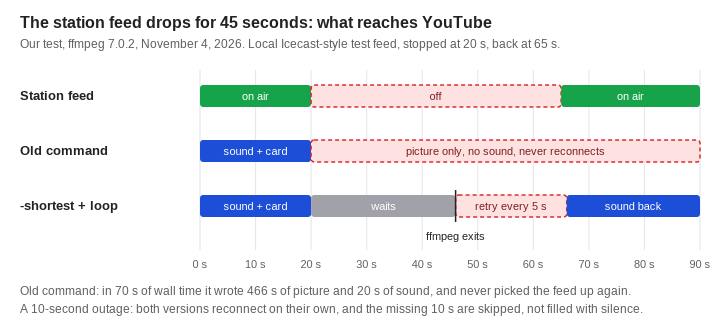
-shortest plus a restart loop. Our test.The fix has two parts. -shortest ends the output when the audio ends, so ffmpeg exits instead of sending a silent card. A loop around the command then starts it again:
#!/bin/bash
# radio-relay.sh: start the relay again whenever ffmpeg exits
while true; do
  ffmpeg -reconnect 1 -reconnect_streamed 1 -reconnect_delay_max 30 \
    -i "https://stream.example.org/talk.mp3" \
    -loop 1 -framerate 30 -i station-card.png \
    -map 1:v -map 0:a -c:v libx264 -preset veryfast -tune stillimage \
    -pix_fmt yuv420p -g 60 -b:v 3000k -maxrate 3000k -bufsize 6000k \
    -x264-params nal-hrd=cbr \
    -c:a aac -b:a 128k -ar 44100 -shortest \
    -f flv "rtmp://a.rtmp.youtube.com/live2/YOUR-STREAM-KEY"
  echo "$(date '+%F %T') relay stopped, restarting in 5 s"
  sleep 5
done
In our 45-second test, ffmpeg exited 26 seconds after the feed stopped, the loop retried every 5 seconds while the feed was down (each try failed at once), and the sound was back one second after the feed returned. The picture stopped together with the sound, about 1.3 seconds later. While the feed is down, nothing at all goes to YouTube; we did not test how long YouTube keeps a broadcast waiting for the encoder to come back, so check the stream in YouTube Studio after a long outage. A gap is still better than hours of a silent card. To start the loop after a server reboot as well, run it as a systemd service, as shown in our live cam guide.
When the station is off air: a looped reel
Not every station wants a live relay. Some put a long reel of their own programmes on YouTube around the clock instead: best-of shows, interviews, studio sessions they have the rights to. That is a pre-recorded video, which is a different job from the relay above, and it is built the same way as a podcast 24/7 stream: the audio joined under a still card, in a radio-style rotation with your IDs between the shows.
Before you go live
- Every hour on the stream is talk, your own production, or music with a written licence that names YouTube (and Kick) and live streaming.
- Licensed music: the rights holder has added your channel to their Content ID allowlist.
- The input is a talk-only or cleared mount, not your main music feed.
- Your encoder sends a keyframe every 2 seconds and AAC audio at 44.1 kHz, at a constant bitrate (
nal-hrd=cbrfor a still card). - You have stopped the feed for a minute on purpose and watched the relay exit, restart and bring the sound back.
- The stream key is stored like a password, and the encoder runs on a machine that stays online.
- Your webcast and composition licences still cover what you play on your own player.
FAQ
Does my SoundExchange licence cover YouTube?
No. SoundExchange says that for services offering on-demand access, such as YouTube, "the statutory license does not apply, and a direct license must be obtained from the copyright holder".
Can I simulcast my FM station on YouTube Live?
Only the parts you hold the rights to. YouTube scans every live stream, and a stream that keeps playing third-party music "will be temporarily interrupted or terminated". Talk, news and your own productions are the safe parts to simulcast.
Does a PPL licence cover YouTube in the UK?
Not the Linear Webcast Licence. PPL says audio-visual, music video and TV content "are not covered by this licence", and a YouTube stream is audio-visual.
I have a licence from the artist. Why was my stream still interrupted?
Content ID does not know about your licence. YouTube asks you to get the owner to add your channel to their allowlist, because "your live stream can be interrupted even if you've licensed the third-party content".
Can I stream my radio station on Kick instead?
Kick has no automatic music scanning, but it has no music licence either. It acts on DMCA notices and terminates repeat infringers, so the same rule applies: stream only what you own or are licensed for.
What happens to my YouTube stream if the Icecast feed drops?
In our tests, a 10-second drop was bridged by ffmpeg's reconnect options. After a 45-second drop the usual relay command gave up on the sound but kept sending the still card, silent, and never reconnected. Add -shortest so ffmpeg exits when the sound ends, and run it in a restart loop; then the sound was back one second after the feed returned.
Sources
- SoundExchange: Licensing 101.
- 17 U.S.C. 114 and 37 CFR 380.2 (Cornell LII).
- PPL: Linear Webcast Licence.
- YouTube Help: copyright issues with live streams, how Content ID works, restrictions on claimed music, Audio Library and live encoder settings.
- Kick: DMCA Policy.
- ffmpeg relay command tested on our server; bitrate and feed outage tests (ffmpeg 7.0.2). ffmpeg HTTP protocol options.
- Loopcast: YouTube page and pricing.