

Short answer
The largest lofi channels own or license their music directly. Lofi Girl releases through its own label, Lofi Records, which works "with hundreds of talented producers worldwide". Smaller channels use one of five sources: a label's creator program, YouTube's Audio Library, a paid music library, commissioned producers, or their own tracks.
- Lofi music is copyrighted like any other music. "Copyright free" almost always means "free to use under conditions", and a credit line is not a license.
- Since May 20, 2026, Lofi Girl's music is "no longer free to use in newly published videos".
- Chillhop and StreamBeats are free for videos and streams, but both rule out a 24/7 radio-style stream built on their catalogue.
- For a 24/7 stream, the safe tracks are ones you made or commissioned with streaming rights in writing, plus a Content ID allowlist where the track is registered.
Terms quoted from each label's own pages and YouTube Help. We quote terms; this is not legal advice.
How the big lofi channels do it
The channel everyone pictures, Lofi Girl (15.8 million subscribers on its YouTube about page on November 4, 2026), is a record label with a stream attached. Its own policy page names the company behind it as Lofi Records SAS and says: "Through Lofi Records, we collaborate with hundreds of talented producers worldwide." It also states: "We do not use AI in the creation of artworks, animations or music." (Lofi Girl AI policy, last updated November 2025).
Chillhop Music works the same way: "We hold all the rights to our music and our music is not royalty-free" (Chillhop, Use our Music). The 24/7 stream is the shop window for a catalogue the channel controls.
That is the model to copy if you want a long-running channel: control the rights to everything you play. The rest of this guide goes through the kinds of license you will meet, what each lofi source allows, and the paperwork that lets you prove it when a claim arrives.
The license types you will meet
Every recorded lofi track carries two rights: "Sound recordings and musical compositions are considered two separate works for copyright purposes" (US Copyright Office, Circular 56A). A license for a video or a stream has to cover both: the composition (the melody and chords) and the recording (the file you play). The labels' own wording shows this. StreamBeats calls its free license a "Synchronization and Master Use License": synchronization means putting the composition in a video ("Licensee may synchronize any StreamBeats track with video content"), and the master is the recording (StreamBeats licensing).
| Type | What it gives you | Lofi example | What to check |
|---|---|---|---|
| No license ("all rights reserved") | Nothing. Listening is not permission. | Most tracks on lofi playlists and other channels' streams | Ask the owner and get the answer in writing |
| Free creator license | Use under the label's conditions, for free | Chillhop Creators Program | Sign-up, credit line, platforms named, and the 24/7 clause |
| Free sync and master license | "gratis, worldwide, non-exclusive, royalty-free, non-transferable, and perpetual" | StreamBeats | The restrictions list: no "music-only radio station", no remixes |
| Subscription license | Use on the channels tied to your plan | Epidemic Sound and other libraries | Live and 24/7 use, and what happens when you stop paying (our comparison) |
| Creative Commons BY 4.0 | Use "for any purpose, even commercially" | Netlabel and free-music-site tracks marked CC BY | You "must give appropriate credit, provide a link to the license, and indicate if changes were made" |
| Creative Commons BY-NC or BY-ND | NC: "You may not use the material for commercial purposes". ND: no sharing of "the modified material" | The same sites; the letters are easy to miss | NC means "not primarily intended for or directed towards commercial advantage or monetary compensation"; we leave NC tracks off monetized channels |
| CC0 or public domain | Use "even for commercial purposes, all without asking permission" | Rare for recorded lofi beats | That the person who marked it CC0 owned it |
| Non-exclusive license | You may use the track; so may others | Most libraries and creator programs | You cannot register it in Content ID yourself (see below) |
| Exclusive license or assignment | Only you may use the track, or you own it outright | Commissioned tracks, if the contract says exclusive | Must be in writing and signed (see commissioning) |
Sources for the table: CC BY 4.0, CC BY-NC 4.0 and its legal code, CC BY-ND 4.0, CC0 1.0, StreamBeats licensing, and the US Copyright Act definitions quoted in the commissioning section.
"Royalty free" is not a license type of its own. It means you pay once or by subscription instead of per play. The music is still copyrighted, and the license still decides where you may use it.
Two facts from YouTube's Content ID rules matter for the non-exclusive rows. Owners may only register material they hold exclusively: YouTube lists "Content licensed non-exclusively from a third party" and "Content released under Creative Commons or similar free of charge/open licenses" as ineligible references (YouTube Help, content eligible for Content ID). So a track you licensed non-exclusively is one you cannot register to protect your stream, and a Creative Commons track is one nobody should be claiming.
A credit line is not a license
The most repeated advice about lofi on YouTube is "just credit the artist". Credit is a condition of some licenses (Chillhop, CC BY), but on its own it gives you no rights. YouTube's dispute page lists "Giving credit to the copyright owner", "Owning a copy of the video or song" and "Choosing not to monetize" among things that are "NOT legitimate reasons to dispute a claim" (YouTube Help, dispute a copyright claim). Credit when the license asks for it; get the license first.
The places your music can come from
| Source | Monetized YouTube videos | 24/7 stream of their catalogue | Credit needed | Cost |
|---|---|---|---|---|
| Your own tracks | Yes | Yes | No | Your time or gear |
| Commissioned producers | Yes, if the contract says so | Yes, if the contract says so | As agreed | Per track or per album |
| Chillhop Creators Program | Yes, claims released for signed-up channels | No: "it will be taken down" | Yes | Free with sign-up (YouTube and Twitch only) |
| StreamBeats | Yes | No: "Don't turn your channel into a radio station" | No | Free |
| YouTube Audio Library | Yes, for Partner Program channels | Not addressed on the Audio Library help page | Only Creative Commons tracks | Free |
| Lofi Girl | Not free since May 20, 2026; claims not released | Not free since May 20, 2026 | n/a | Paid commercial license on request |
| Subscription libraries (Epidemic Sound and others) | Yes, on the channels tied to your plan | Depends on the plan; read the terms | Depends on the library | Monthly or yearly plan |
We compare the subscription libraries clause by clause, with prices, in our guide to music licenses for 24/7 streams. What a library costs against what a channel earns is in our guide to whether lofi channels make money.
What each lofi source allows, use by use
"Can I use it?" has a different answer for a background track in an upload, a mix of the label's tracks, and a 24/7 stream. This table puts the free lofi sources side by side for each use. Every cell comes from the source's own page; where the page says nothing, we say so rather than guess.
| Use | Chillhop Creators Program | StreamBeats | Lofi Girl, new videos | YouTube Audio Library | A CC BY 4.0 track |
|---|---|---|---|---|---|
| Background in a monetized upload | Yes, Dashboard tracks, with credit | Yes: "Monetize your content" | Not free: claims stay | Yes, in the Partner Program | Yes: "even commercially", with credit |
| Background in a live stream | Yes, Dashboard tracks only, not the website player | Yes: "Use it in any stream" | Paid license on request | Not addressed | Yes |
| Upload of the tracks as a music mix | No: "not permitted" | No: "Redistribute the music standalone" not allowed | No, not even under the 2022 terms | Not addressed | Yes, with credit |
| 24/7 radio-style stream | No: "it will be taken down" | No: "Use as a music radio station" not allowed | Not free | Not addressed | Yes: "for any purpose" |
| Remix, sample or rap over it | No: "not allowed to sample, edit, remix" | No: "The tracks must be used as-is" | No (2022 terms) | Not addressed | Yes, and "indicate if changes were made" |
| Credit | Required, with link | "No attribution required" | n/a | Creative Commons tracks only | Required |
| Play their Spotify playlists as your source | No: "not permitted" | Not addressed | Not addressed | n/a | n/a |
Two notes on the table. First, a "Yes" here is about copyright only. A channel of other artists' tracks, licensed or not, still has to pass YouTube's monetization review; our guide to inauthentic content and 24/7 channels quotes the policy line on "Collections of songs from different artists (even if you have their permission)". Second, Chillhop's playlist rule is easy to break by accident: its playlists "often feature songs which don't belong to our record label", so a stream fed from them plays tracks no program covers.
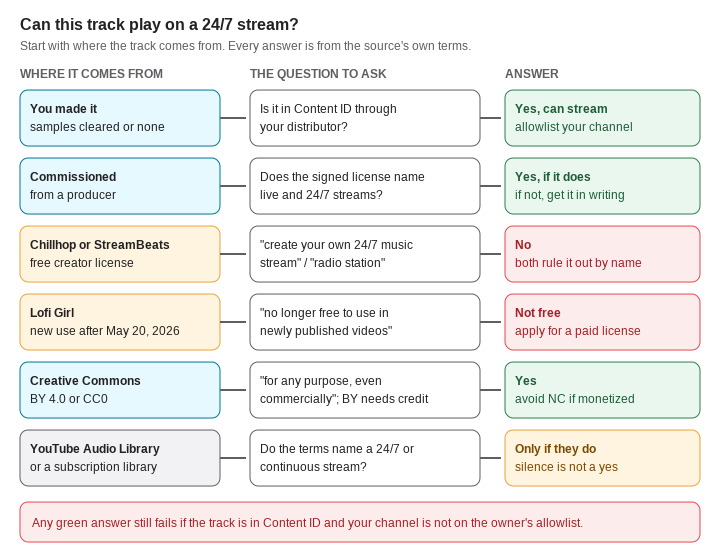
Lofi Girl's music is no longer free for new videos
For years the standard advice was "use Lofi Girl tracks and credit them". That advice is now out of date. Content ID is YouTube's system that matches uploads against files from rights holders and lets them claim the ad money or block the video. Lofi Girl's Content ID page, where creators used to ask for claims to be released, now says:
"As part of our efforts to better protect our catalog and the artists we work with, we recently updated our Content ID policy effective May 20, 2026. As a result, our music is no longer free to use in newly published videos. [...] Videos published after May 20, 2026 are not eligible, and claims on those videos will generally not be removed."Lofi Girl, Content ID
The older terms page (headed "dated 12/04/2022") is still online and still describes free use with a credit line. Where the two disagree, we would follow the newer Content ID page, because that is what decides whether a claim on your video is released. Some pages that rank for "is lofi music copyrighted" or "can I use Lofi Girl music" still say Lofi Girl's music is free to use with credit. As of November 2026, that is wrong for any new upload.
The page also asks creators not to fight claims through YouTube: "Please do not dispute, contest or appeal the claim directly through YouTube. Submitting a dispute may interfere with the process and result in the claim being upheld." Its release form is only for videos "published before May 20, 2026".
There is a paid route. Lofi Girl's commercial license form lists the uses you can apply for, including videos on YouTube and other platforms and livestreams, and warns: "Filling out this form does not constitute permission to use the music." It publishes no prices; the license is whatever Lofi Girl agrees to in writing. The 2022 terms also still describe two rules worth knowing if you ever get a license: the music may not be changed ("You cannot add lyrics, sample, or remix the track"), and the credit format for YouTube is "Artist(s) name – Track title", "Provided by Lofi Girl", plus links to the track.
Is lofi music copyrighted?
Yes. Every lofi track is protected the moment it exists: "Your work is under copyright protection the moment it is created and fixed in a tangible form" (US Copyright Office FAQ; the legal sources on this page are US law, the rules are similar in most countries). There is no registration step that makes a track "copyrighted" and no lofi exception.
What is not protected is the style. "Copyright does not protect facts, ideas, systems, or methods of operation, although it may protect the way these things are expressed" (US Copyright Office FAQ). The idea of dusty drums, jazzy chords and vinyl crackle belongs to no one. A particular melody, beat or recording does.
So "copyright free lofi" is a marketing phrase. In practice it means one of these:
- Free license with conditions: StreamBeats, Chillhop's program and the YouTube Audio Library are all copyrighted music that you may use under their rules.
- Royalty free: you pay a fee or subscription, not per play or per view. The music is still copyrighted.
- Creative Commons: copyrighted, but licensed to everyone on the terms of the CC license named on the track.
- Public domain: genuinely free of copyright, which for recorded lofi beats is rare.
Why a 24/7 stream needs more than a "free" license
Two well-known free catalogues let creators use their tracks, but draw a line at exactly what a lofi channel wants to build:
"Please do not use our music to create your own 24/7 music stream. If this happens, it will be taken down."Chillhop, Use our Music
"Don't turn your channel into a radio station."StreamBeats licensing
Neither page explains why, but the effect is clear: their catalogues can sit under your other videos and streams, not be the backbone of a 24/7 music stream. Chillhop does leave a door open for music channels: "If you happen to run a music-oriented channel, please send us a message and we'll get back to you as soon as possible." If you take it, get the answer in writing.
YouTube's live scanning adds a second problem. YouTube checks live streams against Content ID, and a match can stop a stream while it is on air. An allowlist is the rights holder's list of channels that may use their music without being flagged:
"When third-party content is identified, a placeholder image may replace your live stream. [...] If your channel isn't added to their allowlist, your live stream can be interrupted even if you've licensed the third-party content."YouTube Help, Copyright issues with live streams
So for a stream, a license on paper is not enough. The rights holder also has to put your channel on its Content ID allowlist, or not register the tracks in Content ID at all. YouTube's page for rights holders explains how that allowlist works, and three details matter to you (YouTube Help, exempt channels from Content ID claims):
- They need your channel ID, "the 24 character alphanumeric string that starts with 'UC'". Put it in the license.
- It only works going forward: "any existing claims made before adding them to your allowlist won't be automatically released."
- Every owner has to do it: "If more than one partner owns an asset, each partner must add a channel to their allowlist to prevent claims against this asset." A track co-owned by a producer and a label needs both.
Building the stream itself, from cleared tracks to a file that loops without a gap, is covered step by step in our 24/7 lofi stream guide.
Making your own lofi: samples, packs and your own Content ID
Your own tracks are the only source with no 24/7 clause to read. Two things can still go wrong: the parts you built them from, and your own distributor.
Sample packs are licensed, not owned. Many lofi producers build on drum kits, loops and one-shots from sample packs. Splice's terms, for example, put it plainly: "Sounds are licensed, not sold, to you", and "you will not own the Sounds". You may use them in "new recordings", but not "in isolation as sound effects, loops, or as source material for any other form of sample". For each sound you can download a "Certified License", described as "for purposes of evidencing your download to a third party (e.g. distributors, labels, audiovisual media companies, etc.)" (Splice Terms of Use, last updated July 24, 2026). Other stores have their own terms; keep whatever proof each one gives you with the project.
YouTube's Content ID rules point the same way. They list "Sound effects, soundbeds, or production loops" as ineligible to register, and say matches against "So-called "royalty free" production music libraries" "must be routed to manual review before claiming" (YouTube Help, content eligible for Content ID). A loop from a pack should not, on its own, be what gets your track claimed. If it is, your pack license is the evidence for the dispute.
Your own distributor can claim your stream. If you release your tracks to streaming services and opt into YouTube Content ID through a distributor, your recordings become references that Content ID matches against every channel, yours included. YouTube says Content ID "doesn't claim videos from channels linked to your Content Manager", but a channel that is not linked to the distributor's Content Manager is matched like any other, so the fix is the allowlist. Add your channel before the first upload or stream that uses the tracks, since earlier claims "won't be automatically released". If a co-producer or label shares the track, each of them has to allowlist you too.
What the 2022 Lofi Girl takedown teaches a small channel
In July 2022 YouTube took down Lofi Girl's long-running streams after copyright complaints from a Malaysian company, FMC Music. TeamYouTube later said it had "confirmed the takedown requests were abusive & terminated the claimants account" and reinstated the videos (TechCrunch, July 11, 2022). NPR reported that "the stream returned two days later" (NPR, July 16, 2022).
Lofi Girl owned its music and still went dark for two days. The lessons for a smaller channel:
- Keep the paperwork. A written license or contract for every track helps you answer a false claim quickly.
- Keep a track list. Know which file, from which source, plays at which point of your loop.
- Keep the source files. If a stream is taken down, you want to be able to start it again from your own copy.
The records section below turns those three into a file-by-file routine.
Samples, covers and "lofi versions": the trap inside a lot of lofi
Many lofi beats are built on samples of older records. A sampled recording carries both rights, the recording and the composition (Circular 56A, quoted above). And there is no safe length: "There are no legal rules permitting the use of a specific number of words, a certain number of musical notes, or percentage of a work" (US Copyright Office, fair use FAQ).
The safe position for a channel is the one a US federal appeals court put bluntly in 2005: "Get a license or do not sample." (Bridgeport Music v. Dimension Films, 6th Cir. 2005). If you buy beats or commission producers, ask in writing whether the track contains samples and whether they were cleared.
"Lofi versions" of famous songs, anime themes and game music have the same problem from the other side. Even if every sound is newly played, the melody is the composition, and the composition's owner holds the exclusive right to "Prepare derivative works based upon the work" (US Copyright Office, Circular 1). A lofi cover needs the songwriter's side cleared, and a 24/7 stream of covers multiplies the problem by every song in it. The free lofi labels also forbid reworking their own tracks: Chillhop says "it is not allowed to sample, edit, remix, add lyrics or alter the original compositions in any way or form", and StreamBeats lists "Remix, sample, or create derivatives" as not allowed.
AI-generated lofi
Before you put AI-made tracks on a channel, check four things.
- The tool's terms decide what you may do. Suno's terms (effective September 3, 2026) limit free and basic accounts to "lawful, personal and non-commercial purposes". For Pro and Premier subscribers, Suno "assigns to you all of its right, title and interest in and to any Output owned by Suno". Commercial use also depends on how you got the file: "You may not commercially exploit Output that has not been downloaded by you through an approved channel", and "recording or stream ripping are prohibited" (Suno Terms of Service). If your channel earns money, a free-tier track is a no.
- Leave the tool's markers in the file. The same terms say: "You agree not to remove, alter, obscure or circumvent any fingerprint, watermark or metadata Suno appends to an Output for the purpose of concealing or misrepresenting the provenance, service tier, or status of that Output." Our tagging step below adds license fields; it does not strip anything.
- You may not own a copyright in it. The US Copyright Office says AI output can be protected "only where a human author has determined sufficient expressive elements", "but not the mere provision of prompts" (Copyright Office, January 2025). Without copyright you may have little to enforce if someone re-uploads your tracks, and Content ID registration requires "exclusive rights to the material".
- YouTube wants it labelled. Creators must disclose AI content that "Creates music that's the main focus of the video", and the examples include "AI generated music" (YouTube Help, disclosing use of GenAI content). On a lofi upload or stream, the music is the main focus. How to set the label in YouTube Studio is in our relaxing music channel guide.
Where the line falls between "AI music" and a producer who uses AI tools is a common question. YouTube's guidance for music partners gives examples (YouTube Help, disclose Gen AI usage for music content):
- Full Gen AI: "A user enters a text prompt into an AI music generator and downloads the resulting track."
- Partly Gen AI: "An artist uses a GenAI tool to generate one or more specific structural layers (e.g., a bassline or string section) and records their own live vocals and instruments over it."
- No Gen AI: "A producer uses automated AI mastering software to adjust the final equalization, compression, and sonic balance of a track."
That page is written for labels delivering music through YouTube's partner feeds, but it is the clearest statement of where YouTube draws the line. It also says YouTube "may use additional signals to augment partner declarations", so an undisclosed AI track can be labelled anyway. If you commission tracks, ask the producer which of the three applies and write it down (the split sheet below has a line for it).
Mass-produced AI uploads also come close to YouTube's "inauthentic content" examples, which include "AI-generated content made with generic or unoriginal templates giving the impression of mass production" (YouTube Help, channel monetization policies). We explain how that policy applies to loop channels in the lofi channel guide and, for the AI label specifically, in our inauthentic content guide.
Commissioning producers and split sheets
If you want the Lofi Girl model on a small budget, you commission or license tracks directly from producers. Three passages of US copyright law explain why the agreement has to be on paper:
- Exclusive rights need a signature. "A transfer of copyright ownership, other than by operation of law, is not valid unless an instrument of conveyance, or a note or memorandum of the transfer, is in writing and signed by the owner of the rights conveyed" (17 U.S.C. 204). An exclusive license counts as a transfer; "a nonexclusive license" does not (17 U.S.C. 101).
- Paying for a track does not make you its author. A commissioned work is only a "work made for hire" if "The work must fall within one of the nine categories of works" listed in the law and "There must be a written agreement between the party that ordered or commissioned the work and individual(s) who actually created the work" (US Copyright Office, Circular 30). Otherwise the producer keeps the copyright and you have whatever license you agreed.
- Co-written tracks have co-owners. A "joint work" is "a work prepared by two or more authors with the intention that their contributions be merged into inseparable or interdependent parts of a unitary whole" (17 U.S.C. 101), and "The authors of a joint work are coowners of copyright in the work" (17 U.S.C. 201).
This is our checklist for a commissioning agreement. It is not legal advice; for a large catalogue, have a lawyer read it.
- Where: YouTube videos, YouTube live streams, Kick, and any other platform you may use. Name 24/7 streams explicitly.
- Money: that you may monetize the channel with the track.
- Content ID: that the producer or their distributor will not register the track in Content ID, or will allowlist your channel ID (the one starting with "UC").
- Samples: that the track contains no uncleared samples, and which packs it uses.
- AI: whether any part was made with AI tools, using YouTube's full, partly or no Gen AI examples above.
- Exclusivity and term: whether others may use the same track, and whether your license ends if you stop paying.
- Credit: the exact credit line the producer wants.
A split sheet for tracks made together
When two or more people make a track (a producer and a keys player, or you and a collaborator), a split sheet is the one-page record of who owns what, signed when the track is finished rather than when it starts earning. Because the composition and the recording are separate works, record a share for each. These are the fields we would put on it:
| Field | What to write |
|---|---|
| Track | Title, working title, date finished, file name of the final master |
| Each contributor | Legal name, artist name, email, and what they did (drums, chords, melody, mixing) |
| Composition share | Percentage of the melody and chords per person, adding up to 100% |
| Recording (master) share | Percentage of the recording per person or label, adding up to 100% |
| Samples and packs | Every sample or loop, its source, and where the license proof is saved |
| AI use | Full, partly or no Gen AI, and which tool |
| Who may license it | Who may say yes to a channel, a 24/7 stream or a sync request, alone or only together |
| Content ID | Whether the track goes into Content ID, through whose distributor, and which channel IDs are allowlisted |
| Signatures | Every contributor, with the date |
The "who may license it" line is the one a 24/7 channel cares about. With co-owners and no agreement on it, you would want every owner's written yes before the track goes into the loop, and every owner's allowlist if the track is in Content ID.
Keep proof with every track (tested)
When a claim arrives in month six of a stream, you need to answer three questions fast: which file is this, where did it come from, and where is the license. The simplest system is a folder per track with the license file, and the license summary written into the audio file itself, so the file carries its own label.
These are the commands we ran with ffmpeg 7.0.2, on a 30-second test tone saved as rainy-window.wav, with a tracks/ folder that already held one untagged file, night-bus.flac. The names are made up for the test.
Step 1: write the license into the file
ffmpeg -hide_banner -loglevel error -i rainy-window.wav \
  -metadata title="Rainy Window" \
  -metadata artist="Example Producer" \
  -metadata copyright="2026 Example Producer" \
  -metadata license="Non-exclusive. YouTube uploads and live streams incl. 24/7 on channel UCxxxxxxxx. Signed 2026-11-04" \
  -metadata comment="Licence: licences/rainy-window.pdf" \
  tracks/rainy-window.flac
This converts the WAV to FLAC (lossless) and adds five tags. Put your real channel ID and license date in the license tag, and the path to the signed license in comment.
Step 2: read it back
ffprobe -v error -show_entries format_tags -of default=nw=1 tracks/rainy-window.flacOur output:
TAG:comment=Licence: licences/rainy-window.pdf
TAG:title=Rainy Window
TAG:artist=Example Producer
TAG:copyright=2026 Example Producer
TAG:license=Non-exclusive. YouTube uploads and live streams incl. 24/7 on channel UCxxxxxxxx. Signed 2026-11-04
TAG:encoder=Lavf61.1.100
Step 3: build a license register and catch untagged files
for f in tracks/*.flac; do
  lic=$(ffprobe -v error -show_entries format_tags=license -of default=nw=1:nk=1 "$f")
  printf '%s\t%s\t%s\n' "$(basename "$f")" "${lic:-MISSING}" "$(sha256sum "$f" | cut -d' ' -f1)"
done > licence-register.tsv
cat licence-register.tsv
Our output (tab-separated):
night-bus.flac	MISSING	f71ba3f93cbc379b82d633653249b744bbc651e262d5e348485728d95d3389ee
rainy-window.flac	Non-exclusive. YouTube uploads and live streams incl. 24/7 on channel UCxxxxxxxx. Signed 2026-11-04	16705a1b9c0b82f272222e9e41880e618b05831799b19b824a80c40b8924d5f9
Any line with MISSING is a track with no recorded license: leave it out of the loop until it has one. The last column is a SHA-256 fingerprint of the exact file. It changes if the file changes (re-tagging included), so make the register after tagging, and keep it with your licenses: it shows which file you had on which day.
What we found: the tags do not survive every format
We converted the tagged FLAC to other formats with plain ffmpeg defaults and read the tags back:
| Format | title, artist, copyright, comment | Custom license tag |
|---|---|---|
| FLAC | Kept | Kept |
| MP3 | Kept | Kept |
| WAV | Kept | Dropped |
| M4A (AAC) | Kept | Dropped; kept with -movflags use_metadata_tags |
| MKA (Matroska audio) | Kept | Kept |
| MP4 video made from a picture plus the FLAC | Dropped | Dropped |
So keep the tagged FLAC (or MP3) files as your library of record. The stream file you build from them will not carry the tags. ffmpeg's manual explains why: "By default, global metadata is copied from the first input file", and in a video the first input is usually the picture. That is one more reason to keep the track files, the register and a track list with timestamps next to every stream file you put on air.
When a licensed track gets claimed
A Content ID claim names what was matched: YouTube requires claimants to give, for a sound recording, "the Title, Artist, and Record Label" (YouTube Help 2605065). Look the track up in your register first, then follow the label's route before YouTube's:
- Chillhop: if the credit was missing, "(1) Copy and paste the correct credit(s) into your video description, and then... (2) 'Dispute' the claim on YouTube." If you credited correctly and still got a claim, "please contact us and we will quickly resolve the issue."
- StreamBeats: "Fill out the false claim form with your video URL and the track name, and the team will get it resolved."
- Lofi Girl: use the claim release form for videos published before May 20, 2026, and do not dispute on YouTube.
- Creative Commons or public domain tracks: these are on YouTube's list of content that is ineligible as a Content ID reference, so a claim on one is worth disputing with the license link.
- Your own or commissioned tracks: check whether the claimant is your own or your producer's distributor. If so, ask for the claim to be released and your channel allowlisted.
YouTube's own dispute process then runs on fixed clocks (YouTube Help, dispute a copyright claim). After you dispute, "The claimant has 30 days to respond." They can release the claim, let it expire, reinstate it, or file a removal request, and if that request is valid "your video is removed from YouTube and your channel gets a copyright strike". If a reinstated claim is wrong you may be able to appeal, and the claimant "then has 7 days to respond to the appeal". Two warnings from the same page: "once you've submitted a dispute, it can't be canceled", and "Repeated or malicious abuse of the dispute process can result in penalties against your video or channel."
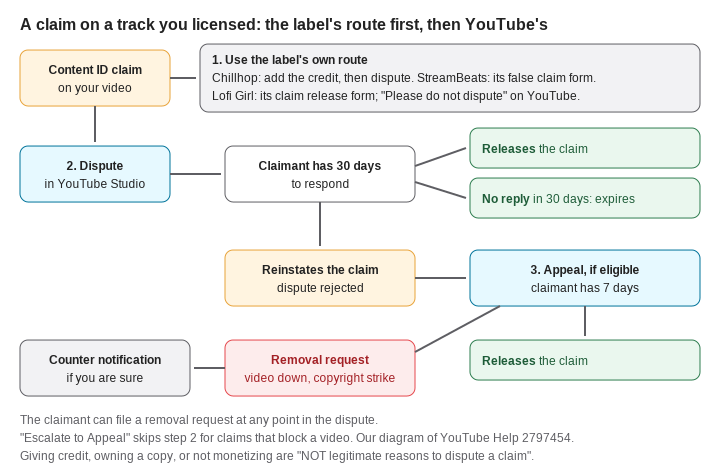
If you do not want to dispute, YouTube Studio offers other ways out for uploads: "Erase song", "Trim out segment", or "Replace song" with a track from the Audio Library (YouTube Help, copyright claims). What a claim does to your ad money and memberships while it stands is covered in our guide to how claims move the money.
Before a track goes into your 24/7 loop
Run every track through these questions. If any answer is "I don't know", leave it out of the loop.
- Do I have a license or proof that I made it, saved where I can find it, and is the file in my register without
MISSING? - Does the license cover live streams, and does it allow a 24/7 or radio-style stream?
- Is my channel allowlisted in Content ID by every owner, or is the track not registered?
- Can I monetize with it?
- Does it contain samples or a cover of someone else's song, and were they cleared? Do I have the pack licenses?
- If it is AI-made, do the tool's terms allow commercial use on my plan, and have I disclosed it?
- If it was made with others, is there a signed split sheet that says who may license it?
For the records themselves, keep one folder per track with: the signed license or terms page saved as a PDF on the day you downloaded the track, sample pack proof, the split sheet if any, the tagged FLAC, and a note of the claim route for that source. Keep the register and a timestamped track list for every stream file.
Planning a 24/7 music stream rather than background music? Most free libraries forbid it; our comparison of music licenses for 24/7 streams quotes each one.
Streaming on Kick as well? Most free licenses name only YouTube and one other platform; our guide to playing copyrighted music on Kick checks which ones cover it.
Once the playlist is cleared, the next step is the stream itself. Our guide to building a 24/7 music stream playlist covers track order and artist spacing, the YouTube live stream time limit guide covers what happens when it runs past 12 hours, our guide to looping a video in OBS Studio covers running the stream from your own PC, and the lofi channel guide puts all the steps in order.
FAQ
Can I use Lofi Girl music on my YouTube channel?
Not in new videos for free. Lofi Girl's Content ID page says that since May 20, 2026 its music "is no longer free to use in newly published videos", and claims on videos published after that date "will generally not be removed". You can apply for a paid commercial license through its form.
Is lofi music copyright free?
No. Lofi tracks are copyrighted like any other music. Some labels and libraries license their tracks for free under conditions, which is what "copyright free" usually means.
If I credit the artist, can I use their lofi track?
Not unless their license says so. Credit is a condition of some licenses, not a license itself. YouTube lists "Giving credit to the copyright owner" among things that are "NOT legitimate reasons to dispute a claim".
Can I make a 24/7 lofi stream with Chillhop or StreamBeats music?
No. Chillhop says "Please do not use our music to create your own 24/7 music stream", and StreamBeats says "Don't turn your channel into a radio station". Both allow their tracks as background music in your other videos and streams.
Can a licensed track still interrupt my live stream?
Yes. YouTube says a live stream "can be interrupted even if you've licensed the third-party content" if your channel is not on the rights holder's Content ID allowlist. Each owner of the track has to add your channel, and claims made before that are not released automatically.
Can I upload a lofi version of a famous song?
Not without clearing the song. A new recording still uses the composition, and its owner holds the exclusive right to "Prepare derivative works based upon the work".
Can I use AI-generated lofi on a monetized channel?
Only if the AI tool's terms allow commercial use on your plan; Suno's free and basic tiers, for example, are limited to personal, non-commercial use. YouTube also requires you to disclose AI content that "Creates music that's the main focus of the video".
What should I do if a track I licensed gets claimed?
Check the track in your records, then use the label's route first: Chillhop asks you to add the credit and dispute, StreamBeats has a false claim form, and Lofi Girl asks you not to dispute on YouTube. Otherwise dispute in YouTube Studio; the claimant has 30 days to respond.
Do I need a split sheet for a track I made with a friend?
If you want to stream or license it, yes. Under US law the authors of a joint work are co-owners, so write down each person's share of the composition and the recording, and who may say yes to a 24/7 stream.
Sources
- Lofi Girl: Content ID policy, commercial license form, terms (dated 2022) and AI policy.
- Lofi Girl YouTube channel, about page (subscriber count).
- Chillhop: Use our Music.
- StreamBeats: Licensing.
- YouTube Help: Audio Library, copyright issues with live streams, exempt channels from Content ID claims, content eligible for Content ID, dispute a copyright claim, copyright claims, disclosing use of GenAI content, disclose Gen AI usage for music content and channel monetization policies.
- US Copyright Office: FAQ, what copyright protects, fair use FAQ, Circular 1, Circular 30, Circular 56A, AI report Part 2 announcement, and the Copyright Act, chapter 1 and chapter 2.
- Creative Commons: BY 4.0, BY-NC 4.0 (legal code), BY-ND 4.0 and CC0 1.0.
- Bridgeport Music, Inc. v. Dimension Films, 410 F.3d 792 (6th Cir. 2005).
- TechCrunch, July 11, 2022 and NPR, July 16, 2022, on the 2022 takedown.
- Suno: Terms of Service (effective September 3, 2026) and Splice: Terms of Use (last updated July 24, 2026).
- ffmpeg documentation; our tests used ffmpeg 7.0.2.