

Short answer
- From YouTube: a channel in the Partner Program gets 55% of net ad revenue on long-form videos and live streams, and 70% of Super Chat and memberships.
- Claims move the money: if Content ID claims the music in a video, the ads on it usually earn for the claimant, and videos with music claims count against channel memberships.
- No published RPM for lofi: no lofi channel we found has published its own. The estimates we found put lofi at $0.90 to $2.50 per 1,000 views, which would make 100,000 views a month worth about $90 to $250 (our arithmetic).
- The big money is in the music: the largest lofi brands are labels that also earn from Spotify and other streaming services.
- Running costs are small: a hosted 24/7 stream costs $0.72 a day; a home PC or a small server costs a few dollars to a few tens of dollars a month.
From YouTube Help, Spotify, the US EIA and provider pricing pages.
First, you need the Partner Program
No ad money reaches a channel until it is in the YouTube Partner Program (YPP). Today that means "1,000 subscribers with 4,000 qualified watch hours in the last 12 months" (YouTube Help, YPP overview and eligibility). From February 1, 2027, new channels need "8,000 qualified watch hours in the last 365 days" instead (YouTube Help, changes to the YPP).
Fan funding comes earlier. In the countries where YouTube runs its expanded program, a channel can join with "500 subscribers with 3 valid public uploads in the last 90 days, and 3,000 qualified watch hours in the last 12 months" and switch on Super Chat, memberships and Super Thanks before it earns anything from ads (YouTube Help, expanded YPP). You also have to "Be at least 18 years old" to use fan funding features (YouTube Help, fan funding). What these bars mean in watch hours per day, and for a channel starting now, is worked out in our guide to starting a lofi YouTube channel; this guide is about what the channel earns once it is in.
Two rules make this harder for a 24/7 channel. Live hours only count if the stream is public and "converted to VOD", and a stream that runs past 12 hours "may not be captured at all". Our guide to live stream time limits explains the trade-off, and the table in live hours and upload hours below sets out what counts and what earns. The channel also has to pass the review for repetitive and reused content, which we cover in inauthentic content and 24/7 channels.
What YouTube pays out of each dollar
| Income | Creator's share | Applies to live streams? | Source |
|---|---|---|---|
| Ads on long-form videos and live streams | 55% of net revenues | Yes: the Watch Page covers "long-form or live streaming videos" | 72902, 94522 |
| Super Chat, Super Stickers | 70% | Yes, they are live chat features | 7288782 |
| Channel memberships, Super Thanks | 70% of net revenues | Memberships are channel-wide | 72902 |
| Shorts | 45% of allocated revenue | No | 12504220 |
| YouTube Premium views | A share of a creator pool (30% of net subscription revenue from Feb 2027) | Not stated | 12843009 |
The ad line in YouTube's words: "YouTube will pay them 55% of net revenues from ads displayed or streamed on their public videos on their content Watch Page." For fan funding, the same page says "YouTube will pay them 70% of net revenues from channel memberships, Super Chat, Super Stickers, and Super Thanks" (YouTube Help 72902), and the Supers page adds: "Creators receive 70% of Supers revenue that is confirmed by Google." From February 2027, Premium views are paid from "a pool representing 30% of net subscription revenue", and every monetizing channel has to "review and accept the updated terms in YouTube Studio by January 31, 2027" (YouTube Help 12843009).
One Shorts detail matters for a music channel. When a Short uses licensed music, YouTube takes a cut for the music before it fills the creator pool, but "Your allocation from the Creator Pool is not affected by your use of a music track" (YouTube Help, Shorts monetization). A clip from your own mix and a silent clip are paid the same way.
Every income source, and the catch for a music channel
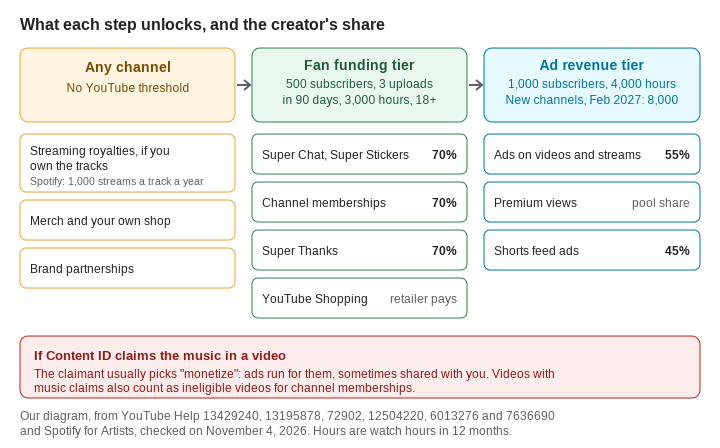
Ads are only one line. The diagram puts every source in the order a channel can switch it on; the table below adds what is different when the content is music.
| Income | When you can switch it on | The catch for a music channel |
|---|---|---|
| Ads on uploads and live streams | Ad revenue tier | If the music is claimed, the ads can earn for the claimant instead (6013276) |
| YouTube Premium | Ad revenue tier | Paid from a pool, not per ad. YouTube says "On average, creators earn more per user from Premium than from ads (based on 2026 performance)." (12843009) |
| Shorts | Ad revenue tier, or the Shorts-views route | Shorts of 1 to 3 minutes with an active claim are blocked (6013276) |
| Super Chat, Super Stickers | Fan funding tier | Only where live chat is on; not on unlisted, private, made for kids or age-restricted streams (9277801) |
| Channel memberships | Fan funding tier | Videos with music claims count as ineligible, and some music channels cannot offer memberships at all (7636690) |
| Super Thanks | Fan funding tier | Same 70% share as the other fan funding features (72902) |
| Merch, YouTube Shopping | Your own shop any time; Shopping features with the fan funding tier | Paid by the shop, not YouTube: "you'll get payments directly from your official merch retailer or platform" (72902) |
| Brand partnerships | Any time | Not in your RPM: YouTube's RPM leaves out "brand deals and sponsorships (excluding YouTube Creator Partnerships)" (9314357) |
| Streaming royalties (Spotify and others) | Only if you own or control the recordings | On Spotify, a track needs 1,000 streams in 12 months to earn (Spotify for Artists) |
Super Chat on a 24/7 stream means an open live chat around the clock, and someone has to look after it while you sleep. Our guide to moderating YouTube live chat covers slow mode, blocked words and moderators across time zones.
When the music is claimed, the money moves
Content ID gives a copyright owner three choices for a video that matches its music: block it, track it, or "Monetize the video by running ads on it, sometimes sharing revenue with the uploader". For music the third is the usual one: monetize is, in YouTube's words, "the most common policy applied to music claims." (YouTube Help, copyright claims). A mix built on tracks you do not control can draw a full audience and earn for someone else.
Claims reach further than the ads on one video:
- Memberships. To offer them, your channel must not have "a significant number of ineligible videos", and "Videos set as made for kids, or videos with music claims are considered ineligible." The same page adds: "Some music channels may not be eligible for channel memberships. For example, music channels under SRAV contract are not eligible right now." (YouTube Help, channel memberships)
- Short clips. For Shorts between 1 and 3 minutes, "Claimed videos will be blocked if there is an active claim applied, regardless of policy." (YouTube Help 6013276)
- Free music programs. Some lofi labels let creators use their music in videos but not run a stream of it. Chillhop's license page says: "Please do not use our music to create your own 24/7 music stream. If this happens, it will be taken down." (Chillhop license). Our comparison of music licenses for 24/7 streams lists what eight sources allow, and our lofi music licensing guide covers commissioning and owning tracks.
- Your own catalogue. Content ID itself is not open to every channel: owners "must own exclusive rights to a substantial body of original material that is frequently uploaded to YouTube" (YouTube Help, how Content ID works).
Then there is the policy every 24/7 channel is reviewed against. On July 15, 2025 YouTube renamed its "repetitious content" policy to "inauthentic content", and said it "includes content that is repetitive or mass-produced". Monetized content should "Not be mass-produced, generic, repetitive, or manipulative." Reviewers look at the channel as a whole and "may focus on your channel's" main theme, most viewed and newest videos, the "Biggest proportion of watch time" and metadata (YouTube Help, channel monetization policies). For a lofi channel whose watch time is mostly one stream, that stream is what gets reviewed. Our guide to inauthentic content and 24/7 channels covers what makes a stream look made rather than mass-produced; the same questions apply to a relaxing music channel or a study with me channel.
RPM, CPM and why we give no lofi RPM
YouTube Studio shows two numbers that are easy to mix up. CPM "is the cost per 1000 ad impressions before YouTube revenue share". RPM "is your total revenue (after YouTube's revenue share) per 1000 views", and it is lower than CPM because RPM "is calculated after YouTube's revenue share" and "includes all views, including ones that weren't monetized" (YouTube Help, ad revenue analytics). RPM is the number that tells you what a view is worth to you. It is not only ads: "RPM is based on several revenue sources, including: ads, channel memberships, YouTube Premium revenue, Super Chat, and Super Stickers." Merch and brand deals are not in it.
We still found no lofi channel that has published its own dated RPM, and YouTube publishes none by genre. What exists are estimates. The most specific we found is a calculator from Every Mood Studio, a company that sells a tool for making ambient videos, which lists lo-fi beats at an estimated $0.90 to $2.50 RPM and says its "Ranges compiled August 2026 from public estimates and creator reports" (Every Mood Studio lofi calculator). It is a vendor's estimate, not anyone's analytics. We use that range below because it is the only lofi-specific one we found with a date and stated sources; replace it with your own RPM from YouTube Studio as soon as you have one.
| Monthly cost | At $0.90 RPM | At $2.50 RPM |
|---|---|---|
| Small cloud server, $4.00 | 4,444 | 1,600 |
| Home PC at 60 W, $7.85 | 8,722 | 3,140 |
| Music library subscription, $9.99 | 11,100 | 3,996 |
| Home PC at 150 W, $19.61 | 21,789 | 7,844 |
| Hosted 24/7 stream, $21.60 | 24,000 | 8,640 |
| Hosted stream plus music library, $31.59 | 35,100 | 12,636 |
The only public look inside a 24/7 lofi stream that we found is old. In January 2020 the channel College Music told the newsletter Water & Music that one of its streams had generated "38 million minutes of watch time, with an average view duration of 52 minutes" in four months (Water & Music, January 29, 2020). The revenue figure in that article is the author's own estimate, so we do not repeat it. The 52-minute average is a measured figure, and we use it in the model below.
Where the Lofi Girl earnings figures come from
Search for how much lofi channels make and most results are about Lofi Girl, often with a figure of about $9,600 a day or $3.5 million a year. Followed back, the figure is a sum, not a disclosure. Reprtoir's 2023 article, citing NaiBuzz, puts it this way: "On average, YouTube creators can get anywhere from $2 to $12 for 1000 monetized views. So for 1.2 million views, this channel can generate about $9600 daily, making about $3.5 million annually." (Reprtoir, August 21, 2023).
The arithmetic behind it: 1,200,000 views ÷ 1,000 × $8 (the middle of $2 to $12) = $9,600 a day, and × 365 = $3.5 million. Three things are wrong with using it:
- The rate is for monetized views. RPM, the figure you would multiply by all views, "includes all views, including ones that weren't monetized" (YouTube Help 9314357), so it is lower.
- The rate is not for music. $2 to $12 is offered as a general range for YouTube creators, not a lofi one.
- The views are an estimate too. The article gives no source for 1.2 million a day.
Put the same 1.2 million views through the $1.20 per 1,000 views that Every Mood Studio quotes as Lofi Girl's publicly estimated rate, and the result is $1,440 a day, or $525,600 a year: 6.7 times less. Neither number is Lofi Girl's revenue. Every earnings figure for a channel built this way moves with the rate someone chose, and the rate is the part nobody outside the channel knows. What the founder has said on the record is in where the big lofi channels earn.
A worked model: from watch hours to dollars
To show the scale of ad income at the Partner Program bar, we ran the numbers with stated inputs. This is our arithmetic, not a forecast for any channel.
| Input | Values | Where it comes from |
|---|---|---|
| Watch hours in a year | 4,000 and 8,000 | The YPP bar today and for new channels from February 1, 2027 (YouTube Help 72851, 12843009) |
| Average view duration | 52 and 20 minutes | 52: College Music's 24/7 stream, 2019 to 2020 (Water & Music). 20: the assumption in our hub's per-day table |
| RPM per 1,000 views | $0.90 to $2.50 | Every Mood Studio's lo-fi estimate range (August 2026) |
The formulas: views = watch hours × 60 ÷ average view duration in minutes; revenue = views ÷ 1,000 × RPM. For example, 8,000 hours × 60 ÷ 52 = 9,231 views, and 9,231 ÷ 1,000 × $0.90 = $8.31.
| Watch hours a year | Average view | Views a year | Revenue a year |
|---|---|---|---|
| 4,000 | 52 min | 4,615 | $4.15 to $11.54 |
| 4,000 | 20 min | 12,000 | $10.80 to $30.00 |
| 8,000 | 52 min | 9,231 | $8.31 to $23.08 |
| 8,000 | 20 min | 24,000 | $21.60 to $60.00 |
The point of the table: reaching the bar lets a channel earn, but the watch time that gets it there is worth tens of dollars a year in ads at these rates. Income depends on how far past the bar the audience grows. At the same RPM range, monthly views turn into monthly revenue like this:
| Views a month | Revenue a month |
|---|---|
| 10,000 | $9 to $25 |
| 50,000 | $45 to $125 |
| 100,000 | $90 to $250 |
| 250,000 | $225 to $625 |
| 1,000,000 | $900 to $2,500 |
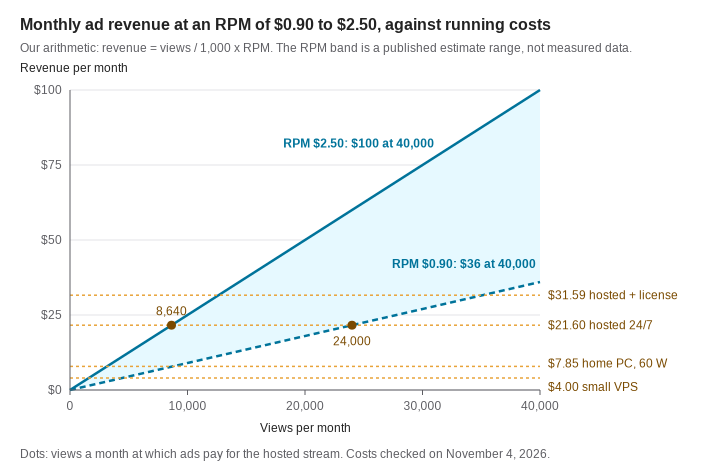
Two limits of the model. First, it treats RPM as fixed per view. On a live stream with automatic mid-rolls, a 52-minute view can carry several ad breaks, so long views may well be worth more than short ones; we found no published figure for how much, so the model does not guess. Second, RPM includes Supers and memberships, but a channel whose videos carry music claims may not be able to offer memberships at all, and the claimed videos' ads may not be yours.
Live hours and upload hours: what counts and what earns
A 24/7 channel collects most of its watch time live, and live time follows different rules from uploads. The thresholds and per-day numbers are in the money section of our lofi channel hub; this table is about where the hours and the ads end up.
| Where the watch time happens | Counts toward YPP watch hours | Ads |
|---|---|---|
| Public uploaded video | Yes | Yes, 55% share once monetized |
| Public live stream, saved as a video afterwards | Yes | Pre-roll and display by default; mid-rolls only if automatic or scheduled, or inserted by hand |
| Live stream that is unlisted, deleted or not converted to VOD | No: excluded by name | While live, the stream's own ad settings apply |
| Live stream longer than 12 hours | Only if it is saved; it "may not be captured at all" | While live, the stream's own ad settings apply |
| Shorts in the Shorts Feed | No, not toward the long-form hours | Shorts pool, 45% share |
| Live stream embedded with auto start on another site | Not stated | No: "ads will be turned off for your live stream" |
The practical reading: for the watch hours, a 24/7 channel needs its streams to end up as public videos, which means restarting before 12 hours or accepting that some hours will not be archived. For the ad money, the stream earns while it is live either way. How to set up planned restarts is in our guide to making a 24/7 lofi stream.
How ads work on a live stream
A common claim, also from 2020, is that a lofi stream serves one ad when a viewer arrives and nothing after. That is not what YouTube says today:
"Pre-roll and display ads are automatically turned on when monetization is turned on for your live stream. Mid-roll ads run during the live stream and you can insert them automatically (recommended) or manually."YouTube Help, monetize your live stream
- Automatic or scheduled mid-rolls. On a schedule, "You can choose the amount of time that you want to pass between ads between 6, 12, 18, 24, or 30 minutes."
- Manual mid-rolls. "If you do not insert any mid-roll ad breaks, no mid-rolls will be served." On a 24/7 stream nobody is there to press the button, so manual is the wrong choice.
- YouTube's own figure. Creators who chose automatic mid-rolls "saw, on average, over 20% uplift in instream ad revenue per hour" (YouTube's average across 207 countries, January 2024).
- Embeds. "If the player is embedded on an external site with auto start, ads will be turned off for your live stream."
How often to run mid-rolls on a music stream is a judgment call: ads every 6 minutes earn more per hour but interrupt the music that people came for.
Where the big lofi channels earn
The largest lofi brands are record labels. In a September 2026 AFP interview, Lofi Girl's founder said the company has worked with close to 1,000 artists, has more than 8,000 tracks in its catalogue and about thirty staff, and splits streaming revenue "à 50-50" with artists (AFP, via La DH, September 19, 2026). The same report says the brand now also sells merchandise, works with brands and plans to open a café in Paris in 2027, that the channel runs about twenty radio streams, and that close to a third of listening comes from the United States, according to the founder. Those are his statements, not published accounts. A label earns each time its tracks are played on Spotify, Apple Music and other services, not only on YouTube.
In 2020 the CEO of Chillhop, another lofi label that started as a YouTube channel, put the preference plainly: "While YouTube is still one of the only platforms where you can build up an audience and talk to them, from a label perspective we actually prefer if people listened to our catalog on Spotify instead of on our livestreams" (Water & Music, January 29, 2020).
Spotify's rules set the floor for that income:
- Since April 1, 2024, "tracks must have reached at least 1,000 streams in the previous 12 months in order to generate recorded royalties" (Spotify for Artists, November 21, 2023).
- Functional noise tracks (white noise, nature sounds and similar) need to be at least two minutes long to earn. What that means for noise channels is in our guide to white noise and sleep sounds channels.
- Spotify does not pay a fixed rate per stream: "So a "per stream" rate isn't actually how anyone gets paid". Its own benchmark for 2025: "capturing one in every million streams on Spotify equals, on average, $11,000" (Spotify Loud & Clear FAQ).
For a new channel, the lesson is about rights more than money. If you stream music you own or commissioned with the streaming rights, the same tracks can earn on music services too. If you stream someone else's catalogue through a creator program, that income is theirs. Our guide to lofi music licensing covers the options.
What it costs to stay on air 24/7
A 24/7 stream needs something sending video around the clock. Here is what each setup costs for 30 days.
| Setup | 30 days | What the price covers |
|---|---|---|
| Hosted: Loopcast (our pick), one platform | $21.60 | Hosting, encoding and automatic restarts. $0.72 per 24 hours, prepaid |
| Hosted: Loopcast, YouTube and Kick together | $37.80 | Second platform at +$0.54 a day |
| Home PC drawing 60 W | $7.85 | Electricity only (43.2 kWh) |
| Home PC drawing 150 W | $19.61 | Electricity only (108 kWh) |
| Small cloud server (VPS) | $4 to $6, or €6.49 plus VAT | The server only: DigitalOcean Basic droplets from $4, Hetzner CPX02 at €6.49. You install and maintain the streaming software |
The PC and server rows leave out the parts that are hard to price: your home connection, wear on the computer, and your time when the stream drops at 3 a.m. Providers do not publish how well their smallest servers handle a 1080p stream, so check the CPU load before you rely on one. The electricity figures are a formula you can redo: watts × 720 hours ÷ 1,000 × your price per kWh (EIA Electric Power Monthly, table 5.6.A, released October 23, 2026).
Music is the other running cost if you do not make or own it. Epidemic Sound's Creator plan is listed at $9.99 a month, "billed $119.88 yearly" (Epidemic Sound pricing). Whether a subscription library allows a round-the-clock music stream differs by provider and is often not stated; our license comparison quotes each provider's terms. Commissioned or self-made music has no monthly fee, and it is the only kind that can also earn on Spotify for you.
For the full build, from playlist length to the loop seam and stream settings, see how to make a 24/7 lofi stream. If lofi is not the format for you, our list of other round-the-clock stream ideas compares the rights, effort and running cost of each.
Checklist: what to sort out before counting on the money
| If this is true | Then |
|---|---|
| You do not own or control the music | Expect claims to take the ads on some videos and to count against memberships. Check the license allows a 24/7 stream before you start one. |
| You own the music, or commissioned it with streaming rights | The same tracks can earn on YouTube and, past 1,000 streams a track a year, on Spotify. This is the label model. |
| You are under 500 subscribers | YouTube pays nothing yet. Merch, brand deals and streaming royalties are the only income. |
| You reach 500 subscribers and 3,000 hours in an expanded-program country | Fan funding opens at 70%. Super Chat needs live chat on, so plan moderation. |
| You reach 1,000 subscribers and the watch-hour bar | Ads open at 55%. Set live mid-rolls to automatic or scheduled, not manual. |
| Most of your watch time is one looping stream | That stream is what the inauthentic content review sees. Make it clearly your own work. |
| Your views are under about 8,600 to 24,000 a month | At the estimated RPM range, ads will not cover a hosted stream; a home PC or small server costs less in money but more in your time. |
FAQ
Do lofi YouTube channels make money?
Channels in the YouTube Partner Program earn 55% of net ad revenue on videos and live streams and 70% of Super Chat and memberships. The largest lofi brands also earn as record labels from music streaming services. YouTube publishes no earnings figures by genre, and music claims can send the ad money on a video to the rights owner instead.
What is the RPM of a lofi channel?
We found no lofi channel that has published its own dated RPM, and YouTube publishes none by genre. The most specific estimate we found, from Every Mood Studio's calculator, is $0.90 to $2.50 per 1,000 views. RPM is your revenue after YouTube's share per 1,000 views; YouTube Studio shows yours once the channel is monetized.
How much does Lofi Girl make?
Nobody outside the company has published it. The figures online, such as $9,600 a day, come from multiplying an estimated 1.2 million daily views by a general $2 to $12 rate for monetized views. At an estimated lofi rate of $1.20 per 1,000 views the same sum gives $1,440 a day. The founder has spoken about artists, staff and a 50-50 streaming split, not revenue.
How many views does a lofi channel need to make $100 a month?
At the estimated range of $0.90 to $2.50 per 1,000 views, about 40,000 to 111,000 views a month (our arithmetic: $100 ÷ RPM × 1,000). Your own RPM may be higher or lower, and ads on videos with claimed music may not be yours.
Can a lofi channel offer memberships?
Only if it qualifies for fan funding and does not have a significant number of ineligible videos. YouTube counts videos with music claims as ineligible, and says some music channels, such as those under SRAV contract, cannot offer memberships right now.
Do live streams show ads all the time?
Pre-roll and display ads are on by default once a stream is monetized, and mid-rolls run during the stream if you choose automatic or scheduled breaks (every 6 to 30 minutes). With manual breaks and nobody pressing the button, no mid-rolls are served.
Do watch hours from a 24/7 stream count toward the Partner Program?
Only for streams that are public and converted to a video afterwards. A stream over 12 hours may not be archived, so its hours may not count.
How much does it cost to run a 24/7 stream?
A hosted service such as Loopcast costs $0.72 a day, about $21.60 for 30 days. A home PC costs its electricity, roughly $8 to $20 a month at the August 2026 US average price for a 60 to 150 W machine, plus your connection and time. A small cloud server starts at about $4 to $6 a month before setup.
Sources
- YouTube Help: partner earnings overview, choose how you want to monetize, Super Chat and Super Stickers and Shorts monetization policies.
- YouTube Help: ad revenue analytics (RPM and CPM) and monetize your live stream.
- YouTube Help: YPP overview and eligibility, changes to the YPP, expanded YPP and archive live streams.
- YouTube Help: fan funding, Super Chat eligibility and channel memberships.
- YouTube Help: copyright claims, how Content ID works and channel monetization policies.
- Spotify for Artists: modernizing our royalty system and Loud & Clear FAQ.
- US EIA, Electric Power Monthly, table 5.6.A (August 2026 data).
- DigitalOcean droplet pricing, Hetzner Cloud pricing, Epidemic Sound pricing and the Chillhop license.
- Every Mood Studio lofi channel calculator (vendor estimate, compiled August 2026) and Reprtoir, August 21, 2023 (quoted to show how a circulating estimate is built).
- Water & Music, January 29, 2020 and AFP via La DH, September 19, 2026 (secondary, labelled as such).
- Loopcast pricing.