

Short answer
- The music decides everything. Make it yourself, commission it, or use a library whose licence covers monetized YouTube videos and, if you stream, a 24/7 loop. YouTube says only its own Audio Library is "known to YouTube to be copyright-safe".
- AI music must be disclosed. YouTube lists "AI generated music" among the content creators must disclose, and AI tools have their own terms: Suno's free tier is for "personal and non-commercial purposes" only.
- Tuning is fine; health promises are the risk. 432 Hz is a tuning choice. A title that promises to cure an illness is a different matter: YouTube's medical misinformation policy names content that "claims that there is a guaranteed cure for cancer outside of approved treatment", and it covers titles and descriptions too.
- Vary the channel. YouTube does not monetize "Similar or repetitive content with low educational value, commentary, narratives, or minimal variation across videos", and its spam policy names channels using "the exact same background music and repetitive AI generated imagery across many videos".
- Join pieces in float. Crossfading loud 16-bit WAV files that share a drone made 13 of 40 joins click in our test; converting to float and adding a limiter fixed every one (test).
- Long uploads and a 24/7 stream work together. Uploads stop at 12 hours; a looped stream can run all day from a hosted service.
From YouTube Help, Suno, ISO, the FTC, the ffmpeg documentation and loopcast.io. Commands first tested on our server; the track join retested and fixed.
1. What people search for
Google's search suggestions show two audiences. Creators type "how to start a relaxing music youtube channel", "how to make meditation music for youtube", "relaxing music youtube channel monetization", "relaxing music youtube channel name ideas" and "meditation music for youtube without copyright". When we typed "how to start a meditation music channel", Google suggested the "relaxing music" versions instead, which is why this guide covers both. Listeners type "meditation music youtube for sleep", "meditation music for anxiety youtube", "432 hz youtube music", "solfeggio frequencies youtube sleep" and "healing frequencies youtube no ads".
Two things follow from that list. The music has a job (sleep, focus, a meditation session, background calm), so each video should say which job it does. And a large share of the listener searches use frequency or healing words, which is where a channel's own titles can get it into trouble (section 4).
2. Make the music yourself or license it
A relaxing music channel is a music channel. Every track needs rights that cover a monetized YouTube video, and a 24/7 stream if you run one. We compare the actual licence terms of the main libraries, clause by clause, in music licences for 24/7 streams, and where music channels get their tracks in lofi music licensing. The same answers apply to calm music; this section only compares the routes.
| Route | Rights | Effort | Watch out for |
|---|---|---|---|
| Make it yourself | Yours, if every sample and loop you use is licensed for release | High, but it is the channel's strongest asset | Sample packs with their own terms; read them |
| Commission a composer | What the contract says: get YouTube, monetization and 24/7 streaming in writing | Cost per track | A contract that only covers "online use" or one video |
| Music library subscription | Per the library's licence | Low | Whether it covers live streams, loops and Content ID clearance (see our licence table) |
| YouTube Audio Library | "copyright-safe"; tracks "won't be claimed by a rights holder through the Content ID system" | Low | Creative Commons tracks need credit in the description; other viewers can use the same tracks |
| AI music tool | Per the tool's terms and your plan | Low | Free plans that rule out commercial use; disclosure (section 3) |
YouTube's warning about other free sources is direct: "Only music and sound effects from the Audio Library are known to YouTube to be copyright-safe. YouTube is not responsible for issues that arise from “royalty-free” music and sound effects from YouTube channels or other music libraries." A search for "meditation music copyright free" will find plenty of such channels.
If you make the music yourself, a long, slow piece is easier to write than a song but harder to keep interesting for an hour. A long video does not have to be one track on repeat: a set of several pieces in a similar key and mood, joined with crossfades (section 6), is easier to sit through for hours.
3. AI-generated music: the tool's terms and YouTube's label
Google suggests "how to make meditation music with ai" and "how to create meditation music with ai". If you plan to, two sets of rules apply.
The tool's terms. Read them for your plan, not the tool's homepage. Suno is one example. Its help centre says that with a Pro or Premier plan "you are considered the owner of the song", and "You also retain the rights to commercial use for the song, even if you end your subscription." On the free Basic tier, "we retain ownership of the songs you generate, but you are allowed to use those songs for non-commercial purposes". Its terms of service put the free tier the same way: "you will only use such Outputs for your lawful, personal and non-commercial purposes." A monetized channel is commercial use, so free-tier songs do not belong on it. Other AI music tools have their own terms; check each one.
YouTube's disclosure rule. YouTube requires creators "to disclose AI-generated or altered content that seems realistic". Its list of what must be disclosed includes content that "Creates music that’s the main focus of the video", and its examples include "AI generated music". In a meditation or relaxing music video the music is the main focus, so an AI soundtrack needs the label. You set it in YouTube Studio: "In the Attributes section, under “AI use,” select Yes if your content meets the disclosure requirements". YouTube says that "For AI-generated music or content that is photorealistic, a label in the video player may also appear", and adds: "Disclosing AI content alone won’t limit a video’s audience or impact its eligibility to earn money." Not disclosing can cost more: creators who consistently do not disclose "may be subject to manual application of a label, or penalties from YouTube, including removal of content or suspension from the YouTube Partner Program." YouTube can also label content itself, including content with "C2PA metadata".
Mass production. AI makes it easy to fill a channel with near-identical hours. YouTube's spam policy describes "Automated or synthetic mass-production" as "Using automated tools or AI to churn out high volumes of similar content with minimal changes", and gives as its example "Channels that use the exact same background music and repetitive AI generated imagery across many videos". Our guide to inauthentic content and 24/7 channels goes through the monetization side of the same rule.
4. 432 Hz, solfeggio and "healing": what you can say
432 Hz refers to tuning. ISO 16, the international standard for musical pitch, "Specifies the frequency for the note A in the treble stave and shall be 440 Hz." Music "in 432 Hz" tunes that A to 432 Hz instead, which lowers every note by the same small amount (section 5). Solfeggio frequency videos use a set of named tones. We make no claims about what any tuning or tone does to the body, and this guide does not repeat the claims made for them. What matters for a channel is what YouTube's rules say about the claims in your titles, descriptions and thumbnails.
YouTube's medical misinformation policy. Its scope, in YouTube's words: "YouTube doesn't allow content that poses a serious risk of egregious harm by spreading medical misinformation that contradicts local health authority (LHA) guidance about specific health conditions and substances." It has two categories, prevention and treatment. Under treatment: "We do not allow content that promotes information that contradicts health authority guidance on treatments for specific health conditions, including promotion of specific harmful substances or practices that have not been approved by local health authorities as safe or effective". The examples that come closest to frequency videos are about cancer:
- "Content that claims that there is a guaranteed cure for cancer outside of approved treatment."
- "Content that discourages people from seeking approved treatments for cancer."
- "Claims that alternative treatments are safer or more effective than approved treatments for cancer."
- "Content that recommends alternative treatments in place of approved treatments for cancer."
The policy reaches beyond the video itself: "These policies apply to videos, video descriptions, comments, live streams, and any other YouTube product or feature." It also covers "external links in your content". So a calm, harmless track can still break the policy through a title, a description or a pinned comment that promises to cure a disease or tells people they can skip treatment. A 24/7 stream is covered as well.
YouTube says the list "isn't a complete list", and the named examples are about serious conditions. The policy does not list music for relaxation or sleep. Its exception for context is narrow: YouTube "may make exceptions for content with educational, documentary, scientific, or artistic context", but adds "This is not a pass to promote misinformation." The consequence, in YouTube's words: "If your content violates this policy, we’ll remove the content and send you an email to let you know." A first violation usually brings a warning; repeats bring strikes, and YouTube "may also terminate your channel or account after a single case of severe abuse, or when the channel is dedicated to a policy violation."
Promises the video cannot keep. YouTube's spam policy separately covers "Malicious clickbait: Using maliciously misleading titles, thumbnails, descriptions, or imagery to trick users into clicking on a video that does not deliver what was promised."
If you sell something. A channel that sells downloads, an app or a course and advertises health benefits is also making advertising claims. In the US, the Federal Trade Commission's guidance for health products says "The FTC approach generally requires that health-related claims be backed by competent and reliable scientific evidence substantiating that the representations are true." Other countries have their own rules. We are not lawyers and this is not legal advice.
The safe way to title a video is to describe what it is: the instruments, the tuning, the length, the mood, and the use ("for sleep", "for a 20-minute meditation"). "Calm piano tuned to 432 Hz, 3 hours" describes the music. "432 Hz cures anxiety and cancer" makes medical promises. If a viewer comment makes such a claim, it sits under your video too; YouTube's policy covers comments.
5. Retune a track to 432 Hz with ffmpeg
If you want a 432 Hz version, the cleanest way is to compose or record with the instrument tuned there. To convert a finished track that you own, this keeps its length and lowers the pitch:
ffmpeg -i track.wav -af "asetrate=48000*432/440,aresample=48000,atempo=440/432" \
-c:a pcm_s16le track-432.wavasetrate, in the ffmpeg manual, sets "the sample rate without altering the PCM data. This will result in a change of speed and pitch." Telling ffmpeg the 48 kHz file is slightly slower makes it play lower and slower by 432/440.aresample=48000converts it back to a normal 48 kHz file.atempo=440/432speeds the tempo back up without changing the pitch, so the length stays the same. Leave it out and the track gets longer instead: by our arithmetic a 60-minute track becomes about 61 minutes 7 seconds (60 x 440 / 432).- Set the two
48000values to your file's sample rate if it is not 48 kHz.
What we tested: with ffmpeg 7.0.2, we ran it on a generated 40-second 440 Hz tone. The output was 40.001 seconds long and its strongest frequency measured 431.99 Hz. Without atempo it measured 432.00 Hz and ran 40.741 seconds. ffmpeg builds that include librubberband can do the same with -af "rubberband=pitch=432/440", which in our test gave 432.01 Hz at exactly 40 seconds; the manual notes the filter needs ffmpeg built with "--enable-librubberband".
The size of the change, by our arithmetic: 432/440 is about 0.982, so every note is about 1.8% lower in frequency, which is about 32 cents, or a third of a semitone (1,200 x log2(432/440) = -31.8 cents).
Only retune music you have the rights to change. Retuning a track does not make it yours, and a licence may not allow edits. YouTube's spam policy also names "Detection evasion: Technical manipulation (such as speeding up audio, heavy filters, cropping) designed to bypass abuse detection." Shifting someone else's song to 432 Hz and uploading it is the kind of thing that wording describes.
6. Join tracks into one long set
If your video is several pieces played in a row, crossfading them into one WAV file first gives you a set with no gaps between pieces. This joins three tracks with 5-second crossfades:
ffmpeg -i one.wav -i two.wav -i three.wav -filter_complex \
  "[0:a]aformat=sample_fmts=flt[a];[1:a]aformat=sample_fmts=flt[b];[2:a]aformat=sample_fmts=flt[c];
   [a][b]acrossfade=d=5:c1=qsin:c2=qsin[ab];
   [ab][c]acrossfade=d=5:c1=qsin:c2=qsin,alimiter=limit=0.95:level=0:latency=1" \
-c:a pcm_s16le set.wavacrossfadefades the end of one input into the start of the next;dis the fade length in seconds. Each extra track adds one moreaformatinput and one moreacrossfadeto the chain.aformat=sample_fmts=fltmakes ffmpeg do the crossfade in floating point instead of on the 16-bit samples of your WAV files, andalimiter=limit=0.95:level=0:latency=1keeps the few moments inside a fade that would go past full scale just under it. Without both, two loud pieces that share a drone can click at the join; see what we found below.level=0turns off the limiter's automatic gain, which would otherwise raise the whole set, andlatency=1keeps the set in time.c1=qsin:c2=qsinchooses a quarter-sine curve instead of the default "triangular, linear slope". In our test the default dipped about 3 dB in the middle of each fade, from -32.0 to -35.0 dB RMS, which is audible in quiet music; withqsinevery 1-second window of the 110-second set measured -32.04 dB.- Each crossfade overlaps the tracks, so the set is shorter than the sum: three 40-second tracks gave 110 seconds (120 minus two 5-second fades).
To turn the set into a long video, repeat the picture without re-encoding it and encode the set's sound once from the WAV, as in the tested 10-hour command in our ambient video guide. We ran that method with this set and a 10-second test picture for 300 seconds: the file played 300 seconds with no silent gap at the joins at 110 and 220 seconds, and its index was at the start of the file. Copying an AAC version of the set instead leaves a small gap at every join; our guide to seamless loop videos explains why, and how to crossfade the end of a set into its start so the repeat is smooth too.
What we found when we retested the join
We retested the command this section published on October 29, which crossfaded the WAV files directly. Our October test pieces were quiet and joined cleanly. Louder pieces did not. Meditation sets often keep one drone under every piece, and when two pieces mastered close to full scale share that drone, the quarter-sine curve can add them up past full scale inside the fade: at the middle of the fade each piece plays at about 71% (sin 45°), so where the drones line up the sum can reach about 1.41 times one piece.
A WAV file cannot hold more than full scale, and here the overflow does not clip. ffmpeg read our 16-bit WAV files as 16-bit samples and did the crossfade on them, and a sum past the top came out at the bottom of the range: a jump across the whole scale, which plays as a hard click. The filter code writes the sum straight into the 16-bit sample with no clipping, in ffmpeg 7.0.2 as on our server and in the current ffmpeg source we read the same day.
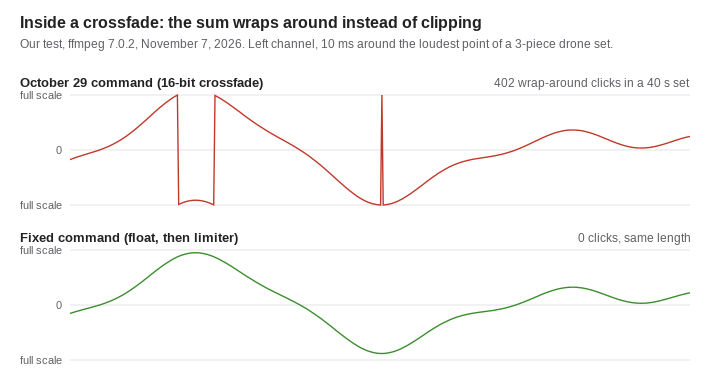
How often it happened, by peak level of the pieces. Each test joined two generated pieces in the same tuning (a drone on 108, 162 and 216 Hz with each piece's own random start phase, plus a different melody), 14 to 20 seconds long, with a 5-second quarter-sine crossfade:
| Peak of each piece | October 29 command | Fixed command |
|---|---|---|
| -0.3 dBFS (a loud master) | 13 of 40 joins clicked, 596 clicks | 0 of 40 |
| -1.0 dBFS | 4 of 40 joins clicked, 158 clicks | 0 of 40, every sample outside the fades unchanged |
| -3.0 dBFS | 0 of 40 | not needed |
- One three-piece set: a 39.7-second set of three loud drone pieces had 402 wrap-around clicks with the old command and none with the fixed one, at the same length to the sample.
- Unrelated music is much safer. Four loud pieces in different keys, with no shared drone, joined without a click; inside the fades the peak reached -0.26 dBFS against -0.3 for the pieces themselves.
- Why not the default curve? The default straight-line fade never adds two pieces past full scale, but it dips about 3 dB in the middle of a fade between unrelated pieces (the test above). The quarter-sine curve in float with a limiter keeps the level and has no clicks.
- What the limiter changes: with pieces peaking at -1 dBFS or lower, the fixed command left every sample outside the fades exactly as it was in all 40 tests. Pieces mastered at -0.3 dBFS have their few peaks above 0.95 (about -0.45 dBFS) brought down by about 0.15 dB.
- Listen for it anyway. A click in a quiet piece is hard to miss on headphones; in a 3-hour set, play 20 seconds around every join before you upload.
7. The picture
Listeners may not watch the screen for long, but the picture is what they see in search results and in the player before the music starts.
- Your own footage: a slow scene you filmed (water, a forest, candles, clouds). The strongest choice; our ambient video guide covers filming, the loop and file size.
- A single illustration or a short animated loop: common and fine, if you hold the rights to the artwork. Our seamless loop guide covers animation cycles that do not jump.
- AI images or video: YouTube requires disclosure when AI "Generates a realistic scene that didn’t actually occur." A photorealistic AI waterfall counts; a clearly drawn scene does not: "Creators don’t need to disclose non-realistic content that’s made with AI". If the music is AI-made too, the music needs the label anyway (section 3).
- Stock photo slideshows: YouTube's monetization policies list "Image slideshows, templated storylines, or scrolling text with minimal or no narrative, commentary, or educational value" among content that is not allowed to monetize. A rotating set of stock photos over the same music is close to that wording.
8. Monetization and repetitive content
"Relaxing music youtube channel monetization" is one of the top suggestions, and the answer is mostly about originality. YouTube's monetization policies say content must "Be your original creation. If you borrow content from someone else, you need to change it significantly to make it your own." It must also "Not be mass-produced, generic, repetitive, or manipulative." The list of what is not allowed to monetize starts with "Similar or repetitive content with low educational value, commentary, narratives, or minimal variation across videos". In July 2025 YouTube renamed this policy from "repetitious content" to "inauthentic content" and said this type of content "has always been ineligible for monetization". And: "Our reused content policy applies to your channel as a whole."
For a calm music channel, what makes videos different is the music: new pieces, a different instrument, a different mood or length for a different use. The same three hours re-titled "for sleep", "for study" and "for yoga" is the minimal variation the policy describes. For what calm and lofi channels earn, with sourced figures, see do lofi channels make money; we have no reliable earnings data for meditation channels specifically and do not guess one.
9. Uploads or a 24/7 stream?
| Option | What listeners get | Limits | Effort and cost |
|---|---|---|---|
| Long upload (1 to 12 hours) | A video found in search, ready for one night or one session | "256 GB or 12 hours, whichever is less" | One upload; no running cost |
| 24/7 looped stream | Music that is always on in the Live tab | "If your stream exceeds 12 hours, it may not be captured at all", so it leaves no video behind | A PC left on, a server, or a hosted loop: on Loopcast $0.72 a day, which Loopcast puts at $21.60 over 30 days |
Most channels need both: uploads for search, one stream that rotates the newest sets, with the uploads linked in its description. Our sleep sounds channel guide compares ten-hour uploads with a stream in more detail; the same trade-offs apply to sleep music. Every licence in the stream must cover live streaming and a loop, not only uploads.
Before you publish
- Every track is yours, commissioned in writing, or from a library whose licence covers monetized YouTube videos and, for a stream, 24/7 looping.
- AI music came from a plan that allows commercial use, and the video is marked "AI use: Yes" in YouTube Studio.
- Any track you retuned is one you have the right to change.
- Title, description, thumbnail and pinned comment describe the music; none promises to treat or cure a condition, or suggests skipping treatment.
- Crossfades between tracks were made in float with a limiter (section 6), and you listened to every join on headphones at bedtime volume.
- A photorealistic AI picture is disclosed; artwork and footage are yours or licensed.
- Each video brings new music, not the same set with a new title.
- Creative Commons tracks are credited in the description.
FAQ
Is 432 Hz music allowed on YouTube?
Tuning music to 432 Hz is a musical choice, and nothing in YouTube's policies is about tuning. What YouTube's medical misinformation policy covers is claims, such as a "guaranteed cure for cancer outside of approved treatment", in the video, title, description, comments or links.
Do I have to disclose AI-generated meditation music?
Yes. YouTube's disclosure list includes "AI generated music" and content that "Creates music that’s the main focus of the video". Disclosure alone does not limit reach or monetization, according to YouTube.
Where can I get meditation music for YouTube without copyright problems?
Make it yourself, commission it, or use a source whose licence you have read. YouTube says Audio Library music is "copyright-safe" and will not be claimed through Content ID; Creative Commons tracks there need credit in your description. Our guide to music licences for 24/7 streams compares the main libraries' terms.
Can a relaxing music channel be monetized?
Yes, if the content is original and varied. YouTube's monetization policies exclude "Similar or repetitive content with low educational value, commentary, narratives, or minimal variation across videos", and the reused content policy applies to the whole channel.
Why does my crossfaded set click at the joins?
If the pieces are loud and share a drone or key, a quarter-sine crossfade can add them up past full scale, and ffmpeg crossfading 16-bit WAV files wraps that sum around to the other end of the scale instead of clipping it. In our test 13 of 40 joins of pieces mastered at -0.3 dBFS clicked. Convert the inputs with aformat=sample_fmts=flt and put alimiter=limit=0.95:level=0:latency=1 after the last crossfade, as in the command in section 6: 0 of 40 clicked.
How is this different from a white noise channel?
Noise can be generated and almost nobody can claim it; music has composers, licences and Content ID. Our sleep sounds guide covers noise and ten-hour uploads; this one covers the music, AI and claims questions.
Sources
- Google search suggestions for the queries quoted in section 1, collected.
- YouTube Help: Use music and sound effects from the Audio Library.
- Suno: Does Suno own the music I make? and Terms of Service.
- YouTube Help: Disclosing use of GenAI content and Spam policy.
- ISO: ISO 16:1975, Acoustics, Standard tuning frequency.
- YouTube Help: Medical misinformation policy.
- US Federal Trade Commission: Health Products Compliance Guidance.
- ffmpeg documentation: filters (asetrate, atempo, rubberband, acrossfade, aformat, alimiter) and the acrossfade source code (af_afade.c). Commands tested on our server with ffmpeg 7.0.2, on generated test tones; the track join retested with generated drone pieces. Nothing was uploaded.
- YouTube Help: YouTube channel monetization policies, upload videos longer than 15 minutes and archive live streams.
- Loopcast: YouTube page and pricing.