

Short answer
- Film it yourself: camera on a tripod at least 3 feet from the fire, manual focus, exposure and white balance locked, one long take of a calm stretch.
- Record the crackle separately or close up, with fans and appliances off, and loop it at a different length from the picture so the two never repeat together for long.
- Crossfade the crackle with
c1=qsin:c2=qsin. In our test, ffmpeg's default fade curve made the fire 3 dB quieter for a second or more at every join; the quarter-sine curve kept it level. - Make a 10-hour file in seconds from a short seamless loop with
-stream_loop, copying the picture and encoding the sound once from WAV; at YouTube's 4K bitrates an hour is about 16 to 20 GB, at 1080p about 3.8 GB (our arithmetic). - The "$1 million fireplace video" is an estimate. The reports trace it to a screenshot of estimated earnings shared on X; no figure from the channel owner has been published.
- One loop is not a channel. YouTube does not monetize channels where content "feels interchangeable from video to video". Vary the fires, the rooms and the seasons.
From YouTube Help, the U.S. Fire Administration, Wikipedia, Dexerto, Oddity Central, UNILAD Tech, the ffmpeg manual and Loopcast, commands tested on our server.
1. Fireplace TV started as a loop
The format is older than YouTube. On Christmas Eve 1966 the New York station WPIX aired the Yule Log: in Wikipedia's words, "a film loop of a Yule log burning in a fireplace", with music, "broadcast without commercial interruption". It was meant for New Yorkers who lived in homes without fireplaces.
Its history holds two lessons for anyone filming a fire today. The first loop was too short: "the original loop was only 17 seconds long, resulting in a visibly jerky and artificial appearance." When WPIX filmed it again in 1970, the new "loop runs approximately six minutes and three seconds." And during the first filming "the producers removed a protective fire grate so that the blaze could be seen better; a stray spark damaged a nearby antique rug valued at $4,000." Long loop, screen in place.
2. Kinds of fireplace video that work on YouTube
| Format | What is in frame | Sound | Watch out for |
|---|---|---|---|
| Classic crackling fire | The firebox and logs, tight | Crackle only | Logs that collapse mid-loop; a visible seam |
| 4K close-up | Flames and embers filling the frame | Crackle only | Large files; only worth it if filmed in 4K |
| Christmas mantel | Fireplace with stockings, lights, a tree | Crackle, or music you are licensed for | Christmas recordings are almost all under copyright |
| Cabin or rain night | Fire plus a window with rain or snow | Crackle mixed with rain or wind | Stock clips in the window count as reused footage |
| No sound | Any of the above | Silent, for people who add their own music | Say it in the title: many people search "with sound" |
A channel that rotates these, in different rooms and fireplaces, has the variety YouTube's monetization rules look for (section 8). For a fire without a fireplace, a wood stove, a campfire or a fire pit work the same way. A fish tank is another long, quiet scene for a locked camera; our guide to making aquarium videos covers filming one through the glass without reflections.
3. Film the fire: camera, settings and safety
A fire is a hard subject for a camera on automatic: the light changes every second, so auto exposure pumps up and down and auto white balance drifts. Lock everything.
- Tripod and distance. The U.S. Fire Administration's rule for the home is: "Keep anything that can burn at least 3 feet from all heat sources including fireplaces". That includes the tripod, the camera, cables and any lights. Zoom in rather than move closer, and keep the fire screen or glass door in place: film through it, or frame so it does not show.
- Focus: manual, set on the front logs. Autofocus hunts on moving flames.
- Exposure: manual or locked (AE lock). Expose for the flames, not the room, so the brightest part keeps its colour. A shutter speed of about twice the frame rate (1/50 s at 25 fps, 1/60 s at 30 fps) keeps flame motion natural.
- White balance: manual. Pick one setting and keep it for the whole take, so the fire does not change colour when a log catches. Whether it looks warm or neutral is your choice; a drifting one is not.
- Frame rate: 24, 25 or 30 fps is plenty for a fire. YouTube's advice is that "Content should be encoded and uploaded in the same frame rate it was recorded."
- Room: turn off room lights, screens and anything that reflects in the glass. Mixed light from a lamp shows up as a second colour on the mantel.
- Long take: record 30 to 60 minutes after the fire is well lit, then pick a calm stretch where no log falls and nobody adds wood. That stretch becomes the loop.
- Never leave it. Stay with the fire while the camera runs. The Fire Administration also says to have chimneys "cleaned and inspected each year by a professional"; do that before filming season, not after.
4. Record the crackle
For "fireplace video with sound", the sound is half the video. The camera's built-in mic hears the room: fans, the fridge, traffic, the camera itself. Better options, in order:
- A separate recorder or a phone on a small stand, close to the fire (still outside the 3-foot zone), pointed at the firebox.
- Record at 48 kHz, the rate YouTube recommends for upload audio, so nothing needs converting.
- Switch off heating fans, the fridge and phones for the take. Hum is very hard to remove later.
- Record longer than the picture: 10 to 20 minutes of steady crackle gives you a clean stretch without pops that stand out.
Then make the sound loop with the same crossfade idea as the picture, and cut low rumble below 60 Hz:
ffmpeg -ss 3 -i crackle.wav -t 3 -i crackle.wav -filter_complex \
  "[0:a][1:a]acrossfade=d=3:c1=qsin:c2=qsin,highpass=f=60" \
  -c:a pcm_s16le crackle-loop.wav
The first input is the recording from second 3 to the end, the second is its first 3 seconds, and acrossfade blends one into the other, so the loop's end runs straight into its start. c1=qsin:c2=qsin sets the fade curve; leave it out and ffmpeg uses a straight line, which leaves a dip in the crackle at every join (our test below). The result is 3 seconds shorter than the recording. For a longer fade, change all three 3s. To set the loop's length, add -t before the first -i: -ss 3 -t 433 -i crackle.wav gives a loop of exactly 433 seconds (tested), which section 5 shows how to choose. Keep the loop as WAV: an AAC loop that is copied end to end gets a short silence at every join (about 37 ms in our test).
Which fade curve keeps the crackle level? Our test
We generated 60 seconds of fire-like sound on our server: a low rumbling bed, different in the left and right channel, with 247 random pops. We made sound loops from it with the command above, with ffmpeg's default curve and with c1=qsin:c2=qsin, then measured the level of the bed (the median of short windows, so pops do not count) across the join. The ffmpeg manual lists the default as "select triangular, linear slope (default)"; qsin is "select quarter of sine wave".
| Fade | Curve | Lowest bed level in the fade | Time more than 2 dB down |
|---|---|---|---|
| 3 s | default (triangular) | -3.0 dB | 1.2 s |
| 3 s | qsin | -1.2 dB | none |
| 10 s | default (triangular) | -3.6 dB | 4.0 s |
| 10 s | qsin | -0.8 dB | none |
Away from the join, the bed moved between -1.4 and +1.7 dB on its own, so only the default curve went below the normal range. The reason (our arithmetic): the end and the start of a recording are unrelated sound. Halfway through a straight-line fade each plays at half strength, and two unrelated sounds at half strength add up to half the power, 3 dB down. The quarter-sine curve keeps each at about 71%, which adds back up to full power. The pops were not the problem: inside the fade both ends' pops play, 4.0 to 4.7 a second against 3.9 to 4.0 elsewhere.
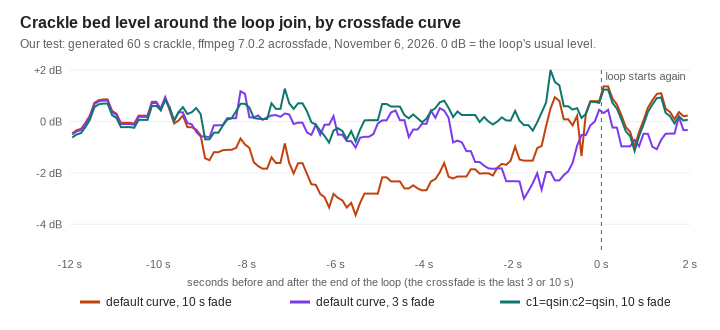
The dip comes back once per sound loop: with a 7-minute loop, about 86 times in a 10-hour file (our arithmetic). It sounds like the fire going quiet for a moment, not like a click. Our test sound was generated, not a real fire; a real recording has the same unrelated ends, so the same curve applies.
5. A seamless loop and a 10-hour file
Making the picture loop without a jump is the same job as for any ambient scene: crossfade the last seconds into the first. Our ambient video guide has the tested xfade command and how to set its numbers; use it on the calm stretch from section 3. Make the loop minutes long, not seconds, for the reason WPIX learned in 1969.
With a video loop (seamless.mp4) and a sound loop (crackle-loop.wav), one command repeats both to 10 hours. The picture is copied without re-encoding; the sound is encoded to AAC once, so no join gets a gap:
ffmpeg -stream_loop 99 -i seamless.mp4 -stream_loop -1 -t 36000 -i crackle-loop.wav \
  -map 0:v -map 1:a -c:v copy -c:a aac -b:a 192k -movflags +faststart fireplace-10h.mp4
-map 0:v -map 1:atakes the picture from the first file and the sound from the second.-stream_loop 99plays a 6-minute picture loop 100 times, exactly 10 hours (36,000 seconds). For your loop, divide 36,000 by its length in seconds and subtract one.-t 36000sits before the sound file, so only the sound is cut. YouTube's upload limit is "256 GB or 12 hours, whichever is less".- Why not
-stream_loop -1on the picture and-t 36000at the end, as this guide said until November 7? With a copied picture, that cut lands part way through a group of frames. On a 300-second test with a 10-second loop it gave 9,002 frames and 300.067 seconds, ending on frame 0 and then frame 3 of the next pass, so a looping stream jumps at every restart. The shape above gave 9,000 frames, 300.000 seconds, sound 300.000 seconds, ending on the loop's last frame (ffmpeg 7.0.2). Details in our seamless loop guide. - Give the two loops different lengths. A 6-minute picture loop with a 7-minute sound loop only lines up again every 42 minutes (our arithmetic: the least common multiple), so a viewer does not hear the same pop at the same flicker every few minutes.
- The picture is not re-encoded, so the 10-hour file has the video bitrate of the loop. Check that bitrate before you run it: the file will be that rate times 10 hours.
What we tested: on our server with ffmpeg 7.0.2, we made a 14-second sound loop from a 17-second noise recording with the first command, and a 10-second picture loop from a generated 1080p clip with the ambient guide's crossfade. The earlier form of the second command (-stream_loop -1 on both, -t 36000 at the end) then built a 10-hour MP4 in about 7 minutes on a busy server: H.264 1080p and AAC, 36,000 seconds long, index at the start of the file, and the last 10 seconds decoded without errors. Its size, 39 GB, matched the loop's 8.6 Mbps over 10 hours. We did not upload it to YouTube.
How often the picture and the crackle line up: our 10-hour test
We ran the 10-hour command above on a 10-second picture loop with a white flash on its first frame and a 14-second sound loop with a short beep at its start, then found every flash and every beep in the finished file. All 3,600 flashes came exactly 10 seconds apart and all 2,571 beeps exactly 14 seconds apart (the largest difference was 0.02 ms), and a flash and a beep came together every 70 seconds, 514 times. The command does not drift, so the pair repeats exactly at the least common multiple of the two lengths, for the whole file. The build took about 3 minutes on our server.
That makes the choice of sound length matter. With a 6-minute picture loop (our arithmetic):
| Sound loop | Picture and sound line up every | Times in a 10-hour file |
|---|---|---|
| 3 min | 6 min (every picture loop) | 100 |
| 4 min | 12 min | 50 |
| 5 min | 30 min | 20 |
| 7 min | 42 min | 14 |
| 7 min 13 s (433 s) | 43 h 18 min | 0 |
A sound loop that fits evenly into the picture loop, or shares a big factor with it, gives the same pop at the same flicker over and over. Check both lengths with ffprobe -v error -show_entries format=duration -of csv=p=0 seamless.mp4 (and the same for crackle-loop.wav), then make the sound loop an odd number of seconds with the -t option from section 4. A camera clip at 29.97 frames per second is not a whole number of seconds; round both lengths to the second for this check, since a viewer notices the same pop at nearly the same flicker, not exact frames.
6. Fireplace video in 4K or 1080p: size per hour
A fire has fine, fast detail, so it shows compression more than a still landscape. YouTube's recommended upload bitrates for SDR video at 24 to 30 fps are 35 to 45 Mbps for 4K and 8 Mbps for 1080p, with 384 kbps for stereo audio.
| Resolution | Video bitrate | 1 hour, about | 10 hours, about | 12 hours under 256 GB? |
|---|---|---|---|---|
| 2160p (4K) | 35 to 45 Mbps | 15.9 to 20.4 GB | 159 to 204 GB | Yes, at 245 GB for 45 Mbps |
| 1440p | 16 Mbps | 7.4 GB | 74 GB | Yes |
| 1080p | 8 Mbps | 3.8 GB | 38 GB | Yes |
4K is worth it only if the camera filmed in 4K; scaling 1080p up adds size, not flames. If you do have 4K footage, it is the version that stands out on a living room TV, which is where many fireplace videos play. Our ambient video guide covers 60 fps and 4K playback.
7. Do fireplace videos make money? What the stories show
The story behind searches like "fireplace video youtube millionaire" is a single video, Fireplace 10 hours full HD, the only upload on a channel called Fireplace 10 Hours. In January 2026 Dexerto reported that the channel "has reportedly made over $1 million in just under ten years. However, some are split on the claims." Here is what the coverage actually rests on.
- The figure is an estimate by a third party. Dexerto describes an X user "posting a screenshot of the video reportedly earning $1.24 million over the last nine years". UNILAD Tech identifies the poster as @Jeremybtc and calls the graph's figures "estimated earnings". Dexerto adds: "Other estimations have the channel earning between $500,000 and $800,000 in the last decade."
- The views are big and old. Oddity Central reports "over 157 million views in under 10 years" for a video uploaded in 2016, and says "it is estimated that the creator has made over $1 million from this video alone."
- Nobody published the creator's own numbers. None of the three reports quotes the channel owner or a YouTube statement on its earnings.
- Even who gets the ad money was argued about. Commenters doubted a one-video channel could be in the YouTube Partner Program; Dexerto notes that "the channel was created before the newly updated rules".
So the honest reading: one early, very long fireplace video became a winter habit for a huge audience, and outside estimates put its lifetime earnings anywhere from about half a million to over a million dollars. It does not show that a new fireplace upload in 2026 will earn that, or anything specific. Viewing also spikes in winter, as UNILAD Tech notes, so expect most of a year's views around December. Our guide on whether lofi channels make money explains how YouTube shares ad revenue with creators.
8. Why a single-loop channel can be refused monetization
A new channel joins the Partner Program by review, not automatically. YouTube's eligibility page says its "automated systems and human reviewers will review your channel as a whole to make sure your channel follows all of our policies and guidelines", and it keeps checking channels after they join. For a fireplace channel, two monetization policies decide that review.
- Inauthentic (repetitive) content. YouTube says "channels where content feels interchangeable from video to video are not allowed to monetize", naming "Similar or repetitive content with low educational value, commentary, narratives, or minimal variation across videos". Twenty uploads of the same fire at 8, 10 and 12 hours, with new titles, are that. Different fireplaces, wood stoves, a snowy cabin, a Christmas mantel and an evening with rain are not.
- Reused content. Looping a stock fireplace clip is content that's "already on YouTube or another online source" unless you add "substantive modifications". And "Our reused content policy applies to your channel as a whole", so a few stock loops can cost the whole channel its monetization. Filming your own fires is the simplest answer.
If an application is refused, YouTube says you "can appeal the decision within 21 days or keep uploading original content" and re-apply after 30 days. Our guide to inauthentic content and 24/7 channels goes through the wording in detail.
9. December: a 24/7 live stream or uploads?
Searches for a "christmas fireplace live stream" peak in one month. A channel can meet them with uploads, a premiere, a stream that runs all of December, or all three.
| Option | What viewers get | Limits | Effort and cost |
|---|---|---|---|
| 10-hour upload | A video found in search all year, every winter again | Up to 12 hours or 256 GB per video | One upload; storage and upload time for 4K |
| Premiere on Christmas Eve | A new fireplace video watched together, with chat | Stays "as a regular upload" afterwards | Low; schedule the upload |
| 24/7 looped stream, December 1 to 31 | A fire that is on whenever someone opens the Live tab | A stream over 12 hours "may not be captured at all", so it leaves no video behind | A PC left on for 744 hours, a server, or a hosted loop: on Loopcast, 31 days at $0.72 is $22.32, or the $20 pack of 32 days |
| Christmas Eve to Boxing Day stream | A fire for the three days most people look for one | Same as above | On Loopcast, 3 days fit in the $5 pack of 7 days, or in the free first week on a new account |
The strongest December plan uses both: new 10-hour uploads in November so they are indexed before the season, and a looped stream through December that links to them in its description. Say in the stream title or description that it is a recorded fire on a loop. If the stream plays Christmas music, it needs a licence for 24/7 public streaming; see our guide to music licences for 24/7 streams. For whether looping a stream is allowed at all, Loopcast's YouTube page sets out the limits.
Before you film and publish
- Tripod, camera, cables and lights are at least 3 feet from the fire, the screen is in place, and someone is with the fire the whole time.
- Focus, exposure and white balance are manual and do not change during the take.
- The loop comes from a calm stretch, is minutes long, and has no visible jump.
- The sound is recorded close, with appliances off, crossfaded with
c1=qsin:c2=qsin, and looped at a length that does not fit evenly into the picture loop. - The upload bitrate fits: a 10-hour 4K file is about 159 to 204 GB.
- Each video is a different fire, room or season, filmed by you.
- Any music is licensed for YouTube, and for 24/7 streaming if it goes in the stream.
- A looped stream says it is a recording.
FAQ
How much money does a fireplace video make on YouTube?
There is no reliable figure. The widely shared story of a fireplace video earning over $1 million is based on third-party estimates of one 2016 video with over 150 million views, ranging from $500,000 to $1.24 million; no confirmation from the creator has been published. A new video earns what its views, audience and ad rates bring, if the channel is accepted into the Partner Program.
How do I make a 10-hour fireplace video?
Film a long take, cut a calm stretch into a seamless crossfaded loop, make a separate crackle loop, then repeat the picture a set number of times with ffmpeg's -stream_loop (100 passes of a 6-minute loop is 36,000 seconds) and cut only the sound to that length. The command in this guide copies the picture and encodes the sound once from WAV.
Why does my fireplace sound get quieter for a moment every few minutes?
Most likely the crossfade at the sound loop's join. ffmpeg's acrossfade uses a straight-line curve unless you set one, and in our test that made the crackle about 3 dB quieter for 1 to 4 seconds at every join. Make the loop again with c1=qsin:c2=qsin, which kept the level steady.
Should a fireplace video be 4K?
Only if you filmed it in 4K. At YouTube's recommended 35 to 45 Mbps an hour of 4K is about 16 to 20 GB, against about 3.8 GB at 1080p (our arithmetic). Upscaled 1080p is bigger without being sharper.
Can I use a stock fireplace clip?
The licence may allow it, but YouTube's reused content rule applies "to your channel as a whole", and a stock loop with no changes is the clearest case of it. Film your own fire, or change and combine stock footage substantially.
Is a Christmas fireplace live stream worth running?
For December, yes, alongside uploads: it sits in the Live tab while people look for one. A stream over 12 hours may not be archived, so it does not replace a 10-hour upload. Say that it is a loop, and license any Christmas music.
Sources
- Dexerto: Creator of YouTube fireplace video estimated to be a millionaire from one video (January 2, 2026); Oddity Central: 10-hour YouTube video of burning fireplace allegedly earned creator over $1 million; UNILAD Tech: fireplace video earnings (January 5, 2026).
- Wikipedia: Yule Log (TV program).
- U.S. Fire Administration: heating fire safety.
- YouTube Help: YouTube channel monetization policies, YouTube Partner Program overview and eligibility, recommended upload encoding settings, uploading videos longer than 15 minutes, archive live streams and Premieres.
- ffmpeg documentation: filters (acrossfade, afade curves).
- Sound loop and 10-hour mux commands tested on our server with ffmpeg 7.0.2, on generated test files; fade curve, loop length and 10-hour picture and sound timing tests.
- Loopcast: YouTube page and pricing.